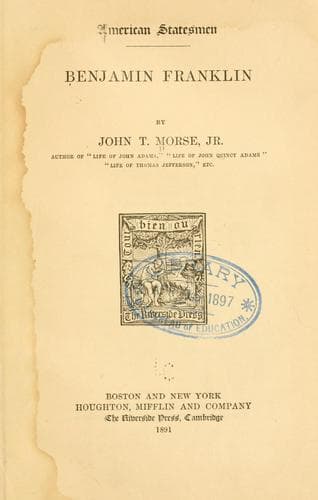
Benjamin FranklinMorse, John T., Jr. (John Torrey)
History
Benjamin Franklin
Morse, John T., Jr. (John Torrey)
Franklin, Benjamin, 1706-1790
The plan which seemed most effective was to send a representative
accredited to some foreign government, and instructed to raise money at
once. Without wasting time by waiting to see whether he arrived safely,
or was received, or was successful in his negotiations, the next ship
which followed him brought drafts and bills which he was expected to
accept, and at maturity to pay. Having thus skillfully shifted the
laboring oar into his hands Congress bestirred itself no further. Poor
Jay, in Spain, had a terrible time of it in this way, and if ever a man
was placed by his country in a painful and humiliating position, it was
he. He faced it gallantly, but had to be carried through by Franklin.
From first to last it was upon Franklin that the brunt fell; he had to
keep the country from financial failure as Washington had to save it
from military failure; he was the real financier of the Revolution;
without him Robert Morris would have been helpless. Spain yielded but
trifling sums in response to Jay's solicitations; Holland, which was
tried by Adams, was even more tardy and unwilling, though towards the
end some money was got there. Franklin alone, at Paris, could tap the
rock and make the waters flow. So upon him Congress sent in an endless
procession of drafts, and compelled him to pay all their foreign bills
and indebtedness; he gathered and he disbursed; to him were referred all
the drafts upon Jay and others, which they themselves could not pay, and
he discharged them one and all. A heavier task never fell upon any man,
nor one bringing less recognition; for money matters usually seem so dry
and unintelligible that every one shirks informing himself about them.
We read about the horrors of the winter camp at Valley Forge, and we
shudder at all the details of the vivid picture. The anxiety, the toil,
the humiliation, which Franklin endured for many winters and many
summers in Paris, in sustaining the national credit, do not make a
picture, do not furnish material for a readable chapter in history. Yet
many a man would far rather have faced Washington's lot than Franklin's.
I do not intend to tell this tale at length or minutely, for I could
trust no reader to follow me in so tedious an enterprise; yet I must try
to convey some notion of what this financiering really meant for
Franklin, of how ably he performed it, of what it cost him in wear and
tear of mind, of what toil it put upon him, and of what measure of
gratitude was due to him for it. It may be worth mentioning by the way
that he not only spent himself in efforts to induce others to lend, but
he himself lent. Before he embarked for Philadelphia on his French
mission, he gathered together all that he could raise in money, some
L3000 to L4000, and paid it over as an unsecured loan for an indefinite
period to the Continental Congress.
Public-domain text, read in full here on John Shaqi.
Reviews
Reviews
No reviews yet
Be the first to share your thoughts on this work.
Elsewhere in the archive
Join the Discussion
Join the discussion
Sign in to leave a comment or review.
Sign InorCreate an account