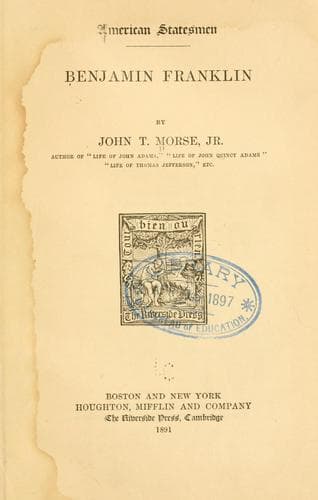
Benjamin FranklinMorse, John T., Jr. (John Torrey)
History
Benjamin Franklin
Morse, John T., Jr. (John Torrey)
Franklin, Benjamin, 1706-1790
In July, 1781, came a broad hint from Robert Morris: "I will not doubt a
moment that, at your instance, his majesty will make pressing
representations in support of Mr. Jay's application, and I hope that the
authority of so great a sovereign and the arguments of his able ministry
will shed auspicious influence on our negotiations at Madrid." This
fulsome language, intended of course to be read to de Vergennes, imposed
the gratifying duty of begging the French minister to second American
begging in Spain.
In the same month Franklin wrote to Morris that the French were vexed at
the purchasing of goods in Holland, and would not furnish the money to
pay for them, and he actually suggested a remittance from America!
"Otherwise I shall be ruined, with the American credit in Europe." He
might have had some motive besides patriotism in thus uniting himself
with the credit of his country; for he had been warned that the consul's
court in Paris had power even over the persons of foreign ministers in
the case of bills of exchange.
September 12, 1781, he announces triumphantly that "the remittances ...
which I requested are now unnecessary, and I shall finish the year with
honor," notwithstanding "drafts on Mr. Jay and on Mr. Adams much
exceeding what I had been made to expect."
He was now informed that Congress would not draw upon _other_ ministers
without providing funds, but that they would continue to draw on _him_
"funds or no funds," an invidious distinction which "terrified" him; for
he had been obliged to promise de Vergennes not to accept any drafts
drawn later than March, 1781, unless he should have in hand or in view
funds sufficient to pay them. But before long he began to suspect that
Congress could outwit the French minister. For so late as January, 1782,
bills dated prior to the preceding April were still coming; and he said:
"I begin to suspect that the drawing continues, and _that the bills are
antedated_. It is impossible for me to go on with demands after
demands." The next month also found these old bills on Laurens still
coming in. Congress never let the ministers know how many bills it was
drawing, perhaps fearing to discourage them by so appalling a
disclosure. Franklin now wrote to Adams: "Perhaps from the series of
numbers and the deficiencies one may be able to divine the sum that has
been issued." Moreover, he reflects that he has never had any
instructions to pay the acceptances of Jay and Adams, nor has had any
ratification of his payments; neither had he "ever received a syllable
of approbation for having done so. Thus I stand charged with vast sums
which I have disbursed for the public service without authority." The
thought might cause some anxiety, in view of the moral obliquity
manifested by Congress in all its financial dealings.
Public-domain text, read in full here on John Shaqi.
Reviews
Reviews
No reviews yet
Be the first to share your thoughts on this work.
Elsewhere in the archive
Join the Discussion
Join the discussion
Sign in to leave a comment or review.
Sign InorCreate an account