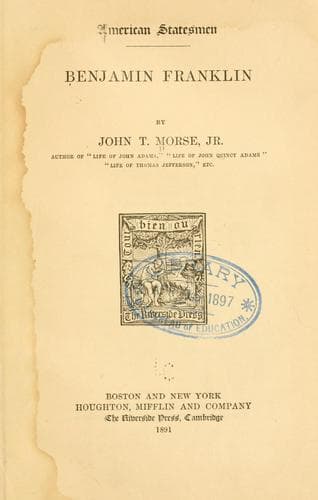
Benjamin FranklinMorse, John T., Jr. (John Torrey)
History
Benjamin Franklin
Morse, John T., Jr. (John Torrey)
Franklin, Benjamin, 1706-1790
Adams was not sufficiently familiar with the modes of political life in
Europe to appreciate what a substantial value Franklin's social and
scientific prestige among the "ladies and gentlemen" and the
"academicians" had there. All those tributes which the great
"philosopher" was constantly receiving may have been, as Adams said,
pleasant food for his vanity, but they were also of practical worth and
service, signifying that he was a man of real note and importance in
what European statesmen regarded as "the world." If Franklin relished
the repast, who among mortals would not? And was his accuser a man to
have turned his back on such viands, had he also been bidden to the
feast of flattery? Franklin's vanity was a simple, amiable, and harmless
source of pleasure to himself; it was not of the greedy or envious type,
nor did its gratification do any injury to any person or any interest.
Jay, a man of generous temper, understood the advantage reaped by the
States from being represented at the French court by a man whose
greatness all Europe recognized. More than once he bore this testimony,
honorable alike to the giver and to him for whom it was given.[72]
[Note 72: See, for example, Franklin's _Works_, vii. 252, note.]
Pleasant as were many of the features of Franklin's residence in France,
and skillfully as he may have evaded some of the more irksome labors
imposed upon him, the attraction was not always sufficient to make him
reluctant to have done with the place. Its vexations and anxieties wore
upon him grievously. He knew that unfriendly representations concerning
him were often made in America, and that these induced some men to
distrust him, and caused others to feel anxious about him. He heard
stories that he was to be recalled, other stories that there was a cabal
to vent a petty ill will by putting an end to the clerkship of his
grandson. This cut him to the quick. "I should not part with the child,"
he said, "but with the employment;" and so the ignoble scheme
miscarried; for Congress was not ready to lose Franklin, and did not
really feel any extreme dread of harm from a lad who, though the son of
a loyalist, had grown up under Franklin's personal influence. At times
homesickness attacked him. When he heard of the death of an old friend
at home he wrote sadly: "A few more such deaths will make me a stranger
in my own country." He was not one of those patriots who like to live
abroad and protest love for their own country. Generally he preserved
the delightful evenness of his temper with a success quite wonderful in
a man troubled with complaints which preeminently make the sufferer
impatient and irascible. Only once he said, when he was being very
unreasonably annoyed about some shipping business: "I will absolutely
have nothing to do with any new squadron project. I have been too long
in hot water, plagued almost to death with the passions, vagaries, and
ill humors and madnesses of other people. I must have a little repose."
Public-domain text, read in full here on John Shaqi.
Reviews
Reviews
No reviews yet
Be the first to share your thoughts on this work.
Elsewhere in the archive
Join the Discussion
Join the discussion
Sign in to leave a comment or review.
Sign InorCreate an account