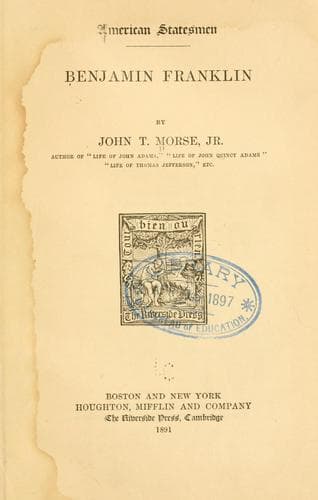
Benjamin FranklinMorse, John T., Jr. (John Torrey)
History
Benjamin Franklin
Morse, John T., Jr. (John Torrey)
Franklin, Benjamin, 1706-1790
A very mild outbreak this, under all his provocations, but it is the
only one of which any record remains. His tranquil self-control was a
very remarkable trait; he was never made so angry by all the calumny and
assaults of enemies peculiarly apt in the art of irritation as to use
any immoderate or undignified language. He never retaliated, though he
had the fighting capacity in him. Before the tribunal of posterity his
patient endurance has counted greatly in his favor.
By March, 1781, he had definitively made up his mind to resign, and
wrote to the president of Congress a letter which was unmistakably
earnest and in parts even touching.[73] When this alarming communication
was received all the depreciation of the Lees, Izard, and the rest went
for nothing. Without hesitation Congress ignored the request, with far
better reason than it could show for the utter indifference with which
it was wont to regard pretty much all the other requests which Franklin
ever made. Its behavior in this respect was indeed very singular. He
recommended his grandson to it, and it paid absolutely no attention to
the petition. He repeatedly asked the appointment of consuls at some of
the French ports; it created all sorts of other officials, keeping Paris
full of useless and costly "ministers" accredited to courts which would
not receive them, but appointed no consul. He urged hard, as a trifling
personal favor, that an accountant might be appointed to audit his
nephew Williams's accounts, but Congress would not attend to a matter
which could have been disposed of in five minutes. He never could get a
secretary or a clerk, nor even any proper appointment of, or salary for,
his grandson. He seldom got an expression of thanks or approbation for
anything that he did, though he did many things wholly outside of his
regular functions and involving great personal risk and responsibility.
Yet when he really wanted to resign he was not allowed to do so; and
thus at last he was left to learn by inference that he had given
satisfaction.[74]
[Note 73: Franklin's _Works_, vii. 207; the letter is unfortunately
too long to quote. See also his letter to Lafayette, _Ibid._ 237.]
[Note 74: See letter to Carmichael, _Works_, vii. 285.]
***
Public-domain text, read in full here on John Shaqi.
Reviews
Reviews
No reviews yet
Be the first to share your thoughts on this work.
Elsewhere in the archive
Join the Discussion
Join the discussion
Sign in to leave a comment or review.
Sign InorCreate an account