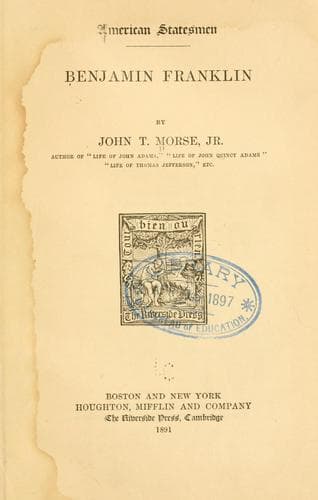
Benjamin FranklinMorse, John T., Jr. (John Torrey)
History
Benjamin Franklin
Morse, John T., Jr. (John Torrey)
Franklin, Benjamin, 1706-1790
Franklin, receiving these epistles, was greatly vexed at the jeopardy
into which the rash zeal of Adams had suddenly plunged the American
interests in France. His indignation was not likely to be made less by
the fact that all this letter-writing to de Vergennes was a tacit
reproach upon his own performance of his duties and a gratuitous
intrenchment upon his province. The question which presented itself to
him was not whether the argument of Adams was right or wrong, nor
whether the distinction which de Vergennes sought to establish between
American citizens and foreigners was practicable or not. This was
fortunate, because, while Adams in the States had been forced to ponder
carefully all the problems of a depreciating paper currency, Franklin in
France had neither necessity, nor opportunity, nor leisure for studying
either the ethics or the solution of so perplexing a problem. He now
hastily made such inquiries as he could among the Americans lately
arrived in Paris, but did not pretend "perfectly to understand" the
subject. To master its difficulties, however, did not seem essential,
because he recognized that the obvious duty of the moment was to say
something which might at least mitigate the present wrath of the French
ministry, and so gain time for explanation and adjustment in a better
state of feeling. He had once laid down to Arthur Lee the principle:
"While we are asking aid it is necessary to gratify the desires and in
some sort comply with the humors of those we apply to. Our business now
is to carry our point." Acting upon this rule of conciliation, he wrote,
on July 10, to de Vergennes:--
"In this I am clear, that if the operation directed by Congress in
their resolution of March the 18th occasions, from the necessity of
the case, some inequality of justice, that inconvenience ought to
fall wholly upon the inhabitants of the States, who reap with it
the advantages obtained by the measure; and that the greatest care
should be taken that foreign merchants, particularly the French,
who are our creditors, do not suffer by it. This I am so confident
the Congress will do that I do not think any representations of
mine necessary to persuade them to it. I shall not fail, however,
to lay the whole before them."
Public-domain text, read in full here on John Shaqi.
Reviews
Reviews
No reviews yet
Be the first to share your thoughts on this work.
Elsewhere in the archive
Join the Discussion
Join the discussion
Sign in to leave a comment or review.
Sign InorCreate an account