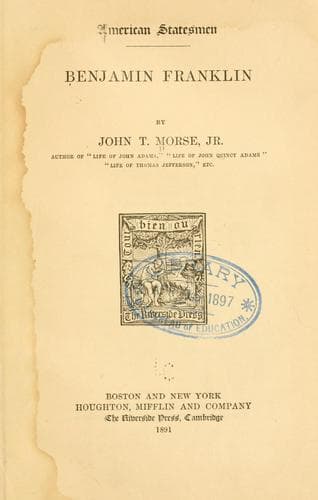
Benjamin FranklinMorse, John T., Jr. (John Torrey)
History
Benjamin Franklin
Morse, John T., Jr. (John Torrey)
Franklin, Benjamin, 1706-1790
In pursuance of this promise Franklin wrote on August 9 a full narrative
of the entire matter; it was a fair and temperate statement of facts
which it was his duty to lay before Congress.[75] Before sending it he
wrote to Adams that de Vergennes, "having taken much amiss some passages
in your letter to him, sent the whole correspondence to me, requesting
that I would transmit it to Congress. I was myself sorry to see those
passages. If they were the effects merely of inadvertence, and you do
not, on reflection, approve of them, perhaps you may think it proper to
write something for effacing the impressions made by them. I do not
presume to advise you; but mention it only for your consideration." But
Adams had already taken his own measures for presenting the case before
Congress.
[Note 75: Franklin's _Works_, vii. 110-112.]
Such is the full story of Franklin's doings in this affair. His
connection with it was limited to an effort to counteract the mischief
which another had done. Whether he thought that the "inconvenience"
which "_ought_ to fall" only on Americans could be arranged to do so,
does not appear; probably he never concerned himself to work out a
problem entirely outside his own department. As a diplomatist, who had
to gain time for angry people to cool down for amicable discussion, he
was content to throw out this general remark, and to express confidence
that his countrymen would do liberal justice. So far as he was
concerned, this should have been the end of the matter, and Adams should
have been grateful to a man whose tranquil wisdom and skillful tact had
saved him from the self-reproach which he would ever have felt had his
well-intentioned, ill-timed act borne its full possible fruit of injury
to the cause of the States. But Adams, who knew that his views were
intrinsically correct, emerged from the imbroglio with an extreme
resentment against his rescuer, nor was he ever able to see that
Franklin did right in not reiterating the same views. He wished not to
be saved but to be vindicated. The consequence has been unfortunate for
Franklin, because the affair has furnished material for one of the
counts in the indictment which the Adamses have filed against him before
the bar of posterity.
Public-domain text, read in full here on John Shaqi.
Reviews
Reviews
No reviews yet
Be the first to share your thoughts on this work.
Elsewhere in the archive
Join the Discussion
Join the discussion
Sign in to leave a comment or review.
Sign InorCreate an account