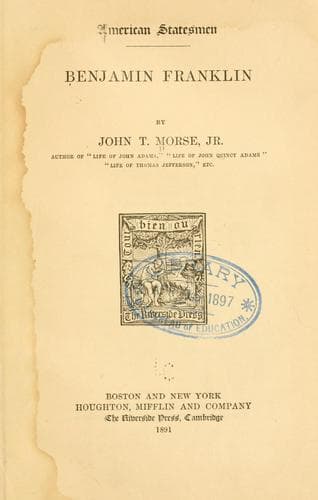
Benjamin FranklinMorse, John T., Jr. (John Torrey)
History
Benjamin Franklin
Morse, John T., Jr. (John Torrey)
Franklin, Benjamin, 1706-1790
knew that Shelburne's tenure of power was precarious, and that any
possible successor of Shelburne would be vastly less well-disposed to
the States. This induced him to stretch a point in order to go on with
the treating. Parliament was to meet on November 26, and unless peace
could be concluded before that time, the chance for it thereafter would
be diminished almost to the point of hopelessness. But Adams wrote from
Holland that he also disapproved the unusual form of the commission,
though a commission to treat with envoys of "the United States of
America" would satisfy him, as a sufficient implication of independence
without an explicit preliminary acknowledgment of it.
[Note 83: Franklin's _Works_, viii. 99, 101, 150, note.]
About the middle of August Jay drew up a letter, suggesting very
ingeniously that it was incompatible with the dignity of the king of
England to negotiate except with an independent power; also that an
obstacle which meant everything to the States, but nothing to Great
Britain, should be removed by his majesty. Franklin thought that the
letter expressed too positively the resolve not to treat save upon this
basis of pre-acknowledged independence. He evidently did not wish to
bolt too securely the door through which he anticipated that the
commissioners might in time feel obliged to withdraw. Moreover Jay
thought that at this time "the doctor seemed to be much perplexed and
fettered by our instructions to be guided by the advice of this court,"
a direction correctly supposed to have been procured by the influence of
the French envoy at Philadelphia.
Public-domain text, read in full here on John Shaqi.
Reviews
Reviews
No reviews yet
Be the first to share your thoughts on this work.
Elsewhere in the archive
Join the Discussion
Join the discussion
Sign in to leave a comment or review.
Sign InorCreate an account