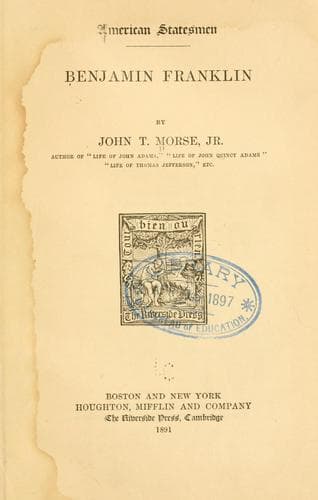
Benjamin FranklinMorse, John T., Jr. (John Torrey)
History
Benjamin Franklin
Morse, John T., Jr. (John Torrey)
Franklin, Benjamin, 1706-1790
Jay's suspicions concerning the French minister happened now to receive
opportune corroboration. On September 4 Rayneval, secretary to de
Vergennes, had a long interview with Jay concerning boundaries, in which
he argued strongly against the American claims to the western lands
lying between the Alleghanies and the Mississippi. This touched Jay
nearly, for the navigation of the Mississippi was the one object which
he had especially at heart. Six days later the famous letter of Marbois,
de la Luzerne's secretary, which had been captured _en route_ from
Philadelphia to de Vergennes at Paris, was put into the hands of Jay
through the instrumentality of the English cabinet. This outlined a
scheme for a secret understanding between England and France to deprive
the Americans of the Newfoundland fisheries. This evidence seemed to
prove Jay's case; yet Franklin remained strangely unshaken by it, for he
reflected that it came from the British ministry and was infected with
suspicion by this channel. But still another occurrence came to
strengthen Jay's conviction of some latent hostility in the French
policy, for he learned that Rayneval was making a rapid and secret
journey to London. He felt sure that this errand was to intimate to
Shelburne that France did not incline to support the demands of her
American allies. In the fullness of his faith he took a courageous,
very unconventional, but eminently successful step. He persuaded Vaughan
to hasten to London, and to present sundry strong arguments going to
show that it was the true policy of England to grant the demands of the
States rather than to fall in with the subtle plans of France. He felt
with regret that he could not consult Franklin regarding this
proceeding, which he undertook upon his own sole responsibility. It put
Shelburne in a singular position, as arbiter between two nations enemies
of England and allies of each other, but each manoeuvring to secure
its own advantage at the cost of its friend, and to that end presuming
to advise him upon English interests. He did not ponder long before
accepting the American arguments as the better, and deciding that the
English policy was rather to be liberal towards a kindred people than to
unite with a traditional foe in curtailing their prosperity. He said to
Vaughan: "Is the new commission necessary?" "It is," replied Vaughan;
and his lordship at once gave orders for making it out. Had he fallen in
with the French ideas, he would, upon the contrary, have cherished this
disagreement for a while, in order finally to sell out a concession on
this point at the price of some such substantial matter as the fisheries
or the western lands. Forthwith Vaughan was on his way back to Paris,
accompanied by a messenger who carried the amended document empowering
Oswald to treat with the commissioners of the "Thirteen United States of
America, viz.: New Hampshire," etc., naming them all. "We have put the
Public-domain text, read in full here on John Shaqi.
Reviews
Reviews
No reviews yet
Be the first to share your thoughts on this work.
Elsewhere in the archive
Join the Discussion
Join the discussion
Sign in to leave a comment or review.
Sign InorCreate an account