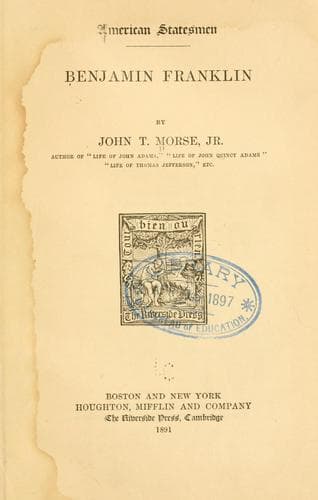
Benjamin FranklinMorse, John T., Jr. (John Torrey)
History
Benjamin Franklin
Morse, John T., Jr. (John Torrey)
Franklin, Benjamin, 1706-1790
greatest confidence, I believe, ever placed in man, in the American
commissioners. It is now to be seen how far they or America are to be
depended upon.... There never was such a risk run; I hope the public
will be the gainer, else our heads must answer for it, and deservedly."
Such were the grave and anxious words of the prime minister.
Upon the receipt of this commission negotiations were actively resumed,
Franklin and Jay on one side, Oswald alone on the other. The old ground
was gone over again. On October 5-8, both parties assented to a sketch
of a treaty, which Oswald transmitted to London for consideration by the
ministry. But the raising of the siege of Gibraltar, and reflection upon
the probable results of the incipient estrangement between American
interests and those of France and Spain, now induced the English to hope
for more favorable terms in some particulars. So instead of adopting
this draft they sent over Mr. Strachey, a man especially well informed
concerning the disputed boundaries, to reinforce Oswald in an effort to
obtain modifications on these points.
Meantime another serious difference of opinion was developed between
Franklin and Jay. The influence of de Vergennes at Philadelphia had by
no means been exhausted in securing colleagues for Mr. Adams. He had
further desired to have the American envoys instructed that no American
demands outside of independence must be allowed to interpose obstacles
in the way of French purposes. In this he had been wholly successful. Of
the demands which Congress had at first intended to insist upon, one
after another was reduced to a mere recommendation, until at last
independence alone was left as an absolute and definitive ultimatum.
Moreover the closing paragraph of the instructions actually bade the
envoys to maintain constant communication with their generous ally the
king of France, and in the last resort to be governed in all matters by
his advice. This servility had raised the ire of Jay almost to the point
of inducing him to refuse a post so hedged around with humiliation. With
his views concerning the intentions of de Vergennes it now seemed to him
intolerable to jeopard American interests by placing them at the mercy
of a cabinet which unmistakably, as it seemed to him, designed to
sacrifice them to its own ends. Accordingly he was for disobeying this
unworthy instruction of Congress, and for conducting the negotiation in
strict secrecy as towards the French minister. But Franklin was no less
resolute on the other side. His established and grateful confidence in
de Vergennes remained unshaken, and he saw no error in consulting the
wisest, and by all proofs the best and truest friend whom the States had
ever had. Moreover he saw that the orders of Congress were imperative.
It was a serious division. Fortunately it was soon settled by the advent
of John Adams, about the end of October. That gentleman, prompt,
fearless, and suspicious, at once fell in with Jay's views. In a long
Public-domain text, read in full here on John Shaqi.
Reviews
Reviews
No reviews yet
Be the first to share your thoughts on this work.
Elsewhere in the archive
Join the Discussion
Join the discussion
Sign in to leave a comment or review.
Sign InorCreate an account