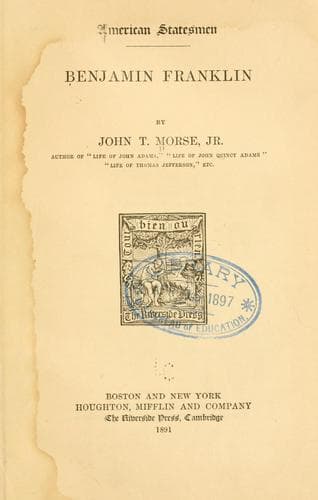
Benjamin FranklinMorse, John T., Jr. (John Torrey)
History
Benjamin Franklin
Morse, John T., Jr. (John Torrey)
Franklin, Benjamin, 1706-1790
So soon as the facts were known in the States expressions of
condemnation were lavished upon the commissioners by members of Congress
who thought that the secrecy as towards France was an inexcusable slight
to a generous and faithful ally. Livingston, as secretary for foreign
affairs, wrote to the envoys, commending the treaty, but finding fault
with the manner of attaining it. Jay, angered at the injustice of a
reproof which belonged more especially to him, drew up an exculpatory
statement. But Franklin, showing his usual good sense and moderation,
sought to mitigate Jay's indignation, drew all the sting out of the
document, and insisted upon leaving the vindication to time and second
thoughts. For his own part Franklin not only had to take his full share
of the reproaches heaped upon the commissioners for insulting France,
but upon the other hand he was violently assaulted on the quite opposite
ground, that he had desired to be too subservient to that power. Many
persons insisted that he "favored, or did not oppose," the designs of
France to rule out the States from the fisheries, and to curtail their
boundaries; and that it was only due to the "firmness, sagacity, and
disinterestedness" of Jay and Adams that these mischiefs were escaped.
Such were the fault-findings and criminations to which the diplomatic
complexities, which it was impossible then to unravel, gave rise.
Fortunately they were soon rendered mere personal and abstract disputes,
of little practical consequence, by the simultaneous execution of
definitive treaties by France and the United States with Great Britain
on September 3, 1783. Many efforts had been made to insert additional
articles, especially as to commercial matters; but they were all
abortive. The establishment of peace had exhausted the capacity of the
States and England to agree together; and the pressure of war being
removed, they at once fell into very inimical attitudes. So the
definitive treaty was substantially identical with the provisional one.
Franklin, after a while, finding that these charges of his having
preferred France to his own country were being reiterated with such
innuendoes as to bring his integrity into serious question, felt it
necessary to appeal to his colleagues for vindication. He wrote to them
a modest, manly letter,[87] and in reply received from Jay a generous
testimonial,[88] and from Adams a carefully narrow acquittal.[89] The
subsequent publication of Franklin's papers written at, and long before,
the time of the negotiation, shows that he was inclined to demand from
Great Britain fully as much as any American upon either side of the
ocean.
[Note 87: _Works_, viii. 340; and see _Ibid._ 353.]
[Note 88: _Ibid._ 350.]
[Note 89: _Ibid._ 354.]
Public-domain text, read in full here on John Shaqi.
Reviews
Reviews
No reviews yet
Be the first to share your thoughts on this work.
Elsewhere in the archive
Join the Discussion
Join the discussion
Sign in to leave a comment or review.
Sign InorCreate an account