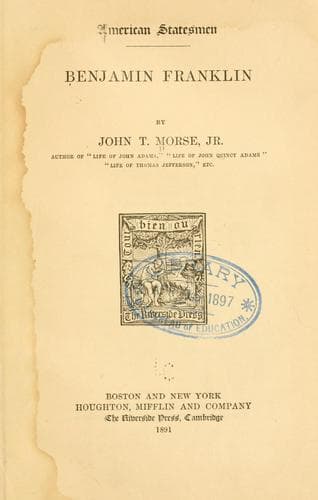
Benjamin FranklinMorse, John T., Jr. (John Torrey)
History
Benjamin Franklin
Morse, John T., Jr. (John Torrey)
Franklin, Benjamin, 1706-1790
In taking leave of the subject it is interesting to know that in point
of fact the secret action of the American commissioners was very nearly
fraught with serious injury to France. For when the States were
practically eliminated from active war by the signing of the provisional
articles, five members of Shelburne's cabinet were in favor of breaking
off negotiations with France, and continuing the contest with her.[90]
[Note 90: I have not endeavored to give a detailed account of this
negotiation, though the narrative would be very interesting, because it
finds its proper place in the life of _John Jay_ in this Series. In that
volume there is a very full and accurate presentation of this entire
affair, drawn from those sources which have only very recently become
public, and which go far to remove former questions out of the realm of
discussion.]
During the negotiation Franklin wrote to Laurens: "I have never yet
known of a peace made that did not occasion a great deal of popular
discontent, clamor, and censure on both sides, ... so that the blessing
promised to peacemakers, I fancy, relates to the next world, for in this
they seem to have a greater chance of being cursed." The prognostication
was fulfilled. The act which gave peace to the warring nations brought
anything but good will among the American negotiators. Jay was so just,
conscientious, and irreproachable a gentleman in every respect that he
escaped unvexed by any personal quarrel; moreover he was not so
distinguished as to have become the victim of envy and jealousy. But the
antipathy previously so unhappily existing between Franklin and Adams
became greatly aggravated, and their respective advocates in historical
literature have not to this day reached an accord. Adams was a
relentless hater, and has bequeathed bitter diatribes, which, as they
can never be obliterated, can never cease to excite the ire of the
admirers of Franklin. On the other side, Franklin has at least the merit
of having left not a malicious line behind him. I have no mind to
endeavor to apportion merits and demerits between these two great
foemen, able men and true patriots both, having no room for these
personalities of history, which, though retaining that kind of interest
always pertaining to a feud, are really very little profitable. Perhaps,
after all, the discussion would prove to be not unlike the classic one
which led two knights to fight about the golden-silver shield.
Public-domain text, read in full here on John Shaqi.
Reviews
Reviews
No reviews yet
Be the first to share your thoughts on this work.
Elsewhere in the archive
Join the Discussion
Join the discussion
Sign in to leave a comment or review.
Sign InorCreate an account