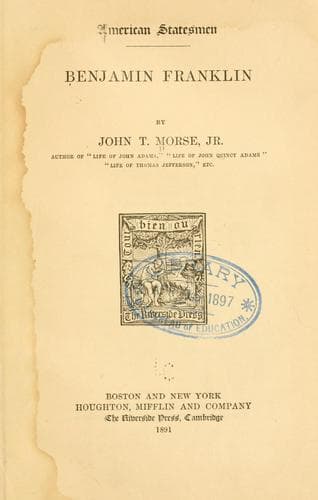
Benjamin FranklinMorse, John T., Jr. (John Torrey)
History
Benjamin Franklin
Morse, John T., Jr. (John Torrey)
Franklin, Benjamin, 1706-1790
In August, 1784, Jefferson arrived to assist in the commercial business.
But it was not until March, 1785, that Congress at last voted that
Franklin might "return to America as soon as convenient," and that
Jefferson should succeed him as minister at the French court. Jefferson
has borne good testimony to Franklin's situation, as he observed it. A
few years later, in February, 1791, he wrote: "I can only therefore
testify in general that there appeared to me more respect and veneration
attached to the character of Dr. Franklin in France, than to that of any
other person in the same country, foreign or native. I had opportunities
of knowing particularly how far these sentiments were felt by the
foreign ambassadors and ministers at the court of Versailles.... I found
the ministers of France equally impressed with the talents and integrity
of Dr. Franklin. The Count de Vergennes particularly gave me repeated
and unequivocal demonstrations of his entire confidence in him." When
Jefferson was asked: "C'est vous, Monsieur, qui remplace le Docteur
Franklin?" he used to reply: "No one can replace him, sir; I am only his
successor;" and we may be sure that the Frenchmen appreciated and fully
agreed with an expression of courtesy which chimed so well with their
own customs of speech. Later, in 1818, Jefferson wrote an interesting
letter concerning the calumnies from which Franklin's reputation still
suffered:--
"Dr. Franklin had many political enemies, as every character must
which, with decision enough to have opinions, has energy and talent
to give them effect on the feelings of the adversary opinion. These
enmities were chiefly in Pennsylvania and Massachusetts. In the
former they were merely of the proprietary party. In the latter
they did not commence till the Revolution, and then sprung chiefly
from personal animosities, which, spreading by little and little,
became at length of some extent. Dr. Lee was his principal
calumniator, a man of much malignity, who, besides enlisting his
whole family in the same hostility, was enabled, as the agent of
Massachusetts with the British government, to infuse it into that
State with considerable effect. Mr. Izard, the doctor's enemy also,
but from a pecuniary transaction, never countenanced these charges
against him. Mr. Jay, Silas Deane, Mr. Laurens, his colleagues
also, ever maintained towards him unlimited confidence and respect.
That he would have waived the formal recognition of our
independence, I never heard on any authority worthy notice. As to
the fisheries, England was urgent to retain them exclusively,
France neutral, and I believe that, had they ultimately been made a
_sine qua non_, our commissioners (Mr. Adams excepted) would have
relinquished them rather than have broken off the treaty. To Mr.
Adams's perseverance alone, on that point, I have always understood
Public-domain text, read in full here on John Shaqi.
Reviews
Reviews
No reviews yet
Be the first to share your thoughts on this work.
Elsewhere in the archive
Join the Discussion
Join the discussion
Sign in to leave a comment or review.
Sign InorCreate an account