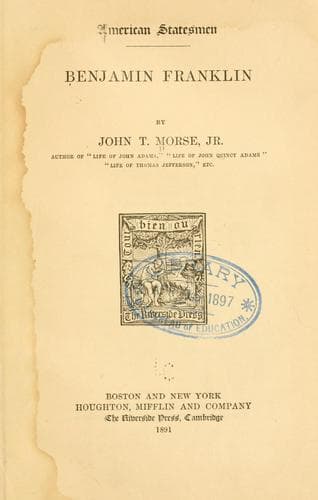
Benjamin FranklinMorse, John T., Jr. (John Torrey)
History
Benjamin Franklin
Morse, John T., Jr. (John Torrey)
Franklin, Benjamin, 1706-1790
we were indebted for their reservation. As to the charge of
subservience to France, besides the evidence of his friendly
colleagues before named, two years of my own service with him at
Paris, daily visits, and the most friendly and confidential
conversation, convince me it had not a shadow of foundation. He
possessed the confidence of that government in the highest degree,
insomuch that it may truly be said that they were more under his
influence than he under theirs. The fact is that his temper was so
amiable and conciliatory, his conduct so rational, never urging
impossibilities, or even things unreasonably inconvenient to them,
in short so moderate and attentive to their difficulties, as well
as our own, that what his enemies called subserviency I saw was
only that reasonable disposition which, sensible that advantages
are not all to be on one side, yielding what is just and liberal,
is the more certain of obtaining liberality and justice. Mutual
confidence produces of course mutual influence, and this was all
which subsisted between Dr. Franklin and the government of
France."[93]
[Note 93: Jefferson's _Works_, vii. 108.]
When at last, in the summer of 1785, Franklin took his farewell of the
much-loved land of France, the distinguished attentions which he
received left no doubt of the admiration in which he was held. Indeed,
many persons pressed him to remain in France, and three offered him
homes in their own families, telling him that not even in America could
he expect esteem and love so unalloyed as he enjoyed in France, and
warning him also that he might not survive the voyage. But he said: "The
desire of spending the little remainder of life with my family is so
strong as to determine me to try at least whether I can bear the motion
of the ship. If not, I must get them to set me ashore somewhere in the
Channel and content myself to die in Europe." When the day of departure
from Passy came "it seemed," said Jefferson, "as if the village had lost
its patriarch." His infirmities rendered the motion of a carriage
painful to him, and the king therefore placed at his disposal one of the
queen's litters, which bore him by easy stages to the seacoast. He
carried with him the customary complimentary portrait of the king; but
it was far beyond the ordinary magnificence, for it was framed in a
double circle of four hundred and eight diamonds, and was of unusual
cost and beauty. On July 18 he arrived at Havre, and crossed the Channel
to take ship at Portsmouth. The British government offset the
discourtesy with which it was irritating Mr. Adams by ordering that the
effects of Dr. Franklin's party should be exempt from the usual
examination at the custom house. His old friend, the Bishop of St.
Asaph, "America's constant friend," came to see him. So also did his
Tory son, the ex-governor of New Jersey, with whom a sort of
reconciliation had been patched up.
Public-domain text, read in full here on John Shaqi.
Reviews
Reviews
No reviews yet
Be the first to share your thoughts on this work.
Elsewhere in the archive
Join the Discussion
Join the discussion
Sign in to leave a comment or review.
Sign InorCreate an account