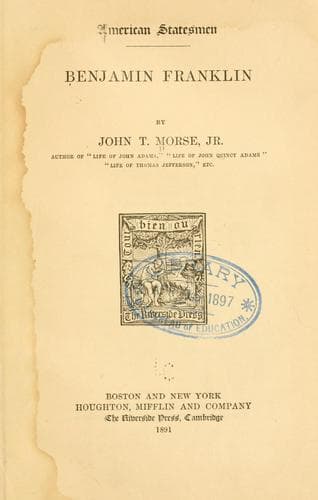
Benjamin FranklinMorse, John T., Jr. (John Torrey)
History
Benjamin Franklin
Morse, John T., Jr. (John Torrey)
Franklin, Benjamin, 1706-1790
He was courageous and cheerful. In November, 1788, he wrote: "You kindly
inquire after my health. I have not of late much reason to boast of it.
People that will live a long life and drink to the bottom of the cup
must expect to meet with some of the dregs. However, when I consider how
many more terrible maladies the human body is liable to, I think myself
well off that I have only three incurable ones: the gout, the stone, and
old age; and, those notwithstanding, I enjoy many comfortable intervals,
in which I forget all my ills, and amuse myself in reading or writing,
or in conversation with friends, joking, laughing, and telling merry
stories, as when you first knew me, a young man about fifty."[101] He
does not seem to have taken undue credit to himself; there is no
querulousness, or egotism, or senility in his letters, but a delightful
tranquillity of spirit. His sister wrote to him that the Boston
newspapers often had matter in his honor. "I am obliged to them," he
wrote; "on the other hand, some of our papers here are endeavoring to
disgrace me. I take no notice. My friends defend me. I have long been
accustomed to receive more blame, as well as more praise, than I have
deserved. It is the lot of every public man, and I leave one account to
balance the other." So serene was the aged philosopher, a _real_
philosopher, not one who, having played a part in life, was to be
betrayed in the weakness and irritability of old age. He felt none of
the mental weariness which years so often bring. He was by no means
tired of life and affairs in this world, yet he wrote in a
characteristic vein to the Bishop of St. Asaph: "The course of nature
must soon put a period to my present mode of existence. This I shall
submit to with the less regret, as, having seen during a long life a
good deal of this world, I feel a growing curiosity to be acquainted
with some other." It was characteristic that in these closing days it
was the progress of mankind in knowledge and welfare which especially
absorbed his thoughts. When he reflected on the great strides that were
making he said that he almost wished that it had been his destiny to be
born two or three centuries later. He was one of the few men who has
left on record his willingness to live his life over again, even though
he should not be allowed the privilege of "correcting in the second
edition the errors of the first."
[Note 101: He habitually wrote in this vein; see, for example,
_Works_, ix. 266, 283, and _passim_.]
Public-domain text, read in full here on John Shaqi.
Reviews
Reviews
No reviews yet
Be the first to share your thoughts on this work.
Elsewhere in the archive
Join the Discussion
Join the discussion
Sign in to leave a comment or review.
Sign InorCreate an account