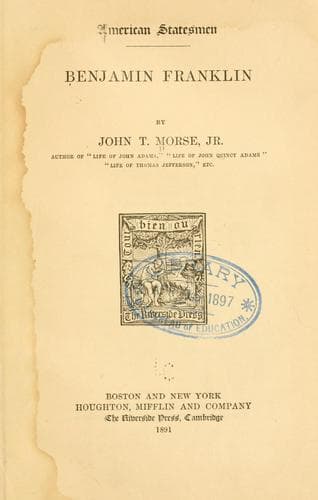
Benjamin FranklinMorse, John T., Jr. (John Torrey)
History
Benjamin Franklin
Morse, John T., Jr. (John Torrey)
Franklin, Benjamin, 1706-1790
The French Revolution excited his profoundest interest. At first he said
that he saw "nothing singular in all this, but on the contrary what
might naturally be expected. The French have served an apprenticeship to
liberty in this country, and now that they are out of their time they
have set up for themselves."[102] He expressed his hope that "the fire
of liberty, ... spreading itself over Europe, would act upon the
inestimable rights of man as common fire does upon gold: purify without
destroying them; so that a lover of liberty may find _a country_ in any
part of Christendom." The language had an unusual smack of the French
revolutionary slang, in which he seems in no other instance to have
indulged. But as the fury swelled, his earlier sympathies became merged
in a painful anxiety concerning the fate of his many good old friends.
[Note 102: Parton's _Life of Franklin_, ii. 600.]
Franklin's last act was a memorial addressed to Congress, signed by him
in his capacity as president of the abolition society, and praying that
body: "That you will devise means for removing this inconsistency from
the character of the American people; that you will promote mercy and
justice towards this distressed race; and that you will step to the very
verge of the power vested in you for discouraging every species of
traffic in the persons of our fellow men." He had always spoken of
slavery with the strongest condemnation, and branded the slave-trade as
"abominable," a "diabolical commerce," and a "crime."
A large part of the last year or two of his life was passed by Franklin
in his bed. At times when his dreadful suffering seemed to become
intolerable, it was quelled, so far as possible, by opium. But at
intervals it left him, and still whenever he thus got a respite for a
few days he was again at work. It was in such an interval that he wrote
his paper condemning the liberty, which was becoming the license, of the
press. If the law permitted this sort of thing, he said, then it should
restore also the liberty of the cudgel. The paper is not altogether
antiquated, nor the idea altogether bad!
It was even so late as March 23, 1790, that he wrote the humorous
rejoinder to the pro-slavery speech delivered in Congress by Jackson of
Georgia. But the end was close at hand; and when this brilliant satire
was composed, there lacked but a few days of the allotted term when that
rare humor was to be stilled forever, and that broad philanthropy was to
cease from the toil in which it had never tired alike for the free and
the oppressed.
Public-domain text, read in full here on John Shaqi.
Reviews
Reviews
No reviews yet
Be the first to share your thoughts on this work.
Elsewhere in the archive
Join the Discussion
Join the discussion
Sign in to leave a comment or review.
Sign InorCreate an account