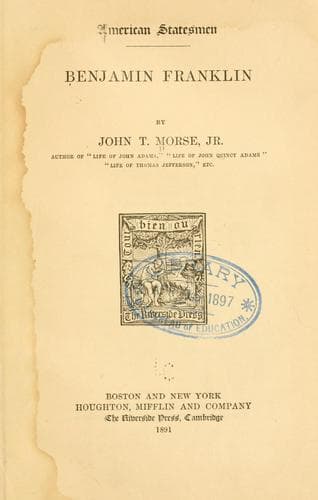
Benjamin FranklinMorse, John T., Jr. (John Torrey)
History
Benjamin Franklin
Morse, John T., Jr. (John Torrey)
Franklin, Benjamin, 1706-1790
On April 12, 1790, a pain in the chest and difficulty of breathing,
which had been giving him much trouble, ceased for a short while, and he
insisted upon getting up in order to have his bed re-made; for he wished
to "die in a decent manner." His daughter expressed the conventional
wish that he might yet recover and live many years. "I hope not," he
replied. Soon afterward the pain returned, and he was advised to change
his position, so that he could breathe more easily. "A dying man can do
nothing easy," he said; and these are the last words which he is known
to have uttered. Soon afterward he sank into a lethargy, and so remained
until at eleven o'clock, P. M., on April 17, 1790, he died.
A great procession and a concourse of citizens escorted his funeral, and
Congress voted to "wear the customary badge of mourning for one month."
The bits of crape were all very well, a conventional, insignificant
tribute; but unfortunately the account of the country, or at least of
Congress as representing the country, did not stand very honorably, to
say nothing of generously, with one of its oldest, most faithful, and
most useful servants.[103] Again and again Franklin had asked for some
modest office, some slight opening, for his grandson, Temple Franklin.
The young man's plans and prospects in life had all been sacrificed to
the service of Franklin as his secretary, which was in fact the service
of the country; yet he had never been able to collect even the ordinary
salary pertaining to such a position. Throughout a long life of public
service, often costly to himself in his own affairs, Franklin had never
asked any other favor than this, which after all was rather compensation
than favor, and this was never given to him. When one reflects how such
offices are demanded and awarded in these days, one hardly knows whether
to be more ashamed of the present or of the past. But this was not all
nor even the worst; for Franklin's repeated efforts to get his own
accounts with the government audited and settled never met with any
response. It needed only that Congress should appoint a competent
accountant to examine and report. Before leaving France Franklin had
begged for this act of simple, business-like justice, which it was the
duty of Congress to initiate without solicitation; he had the fate of
the "poor unhappy Deane" before his eyes, to make him uncomfortable, but
in this respect he was treated no better than that misused man. After
his return home he continued his urgency during his last years, not
wishing to die leaving malignant enemies behind him, and accounts open
which he could no longer explain and elucidate. Indeed, stories were
already circulating that he was "greatly indebted to the United States
for large sums that had been put into [his] hands, and that [he] avoided
a settlement;" yet this request was still, with unpardonable disregard
of decency and duty, utterly ignored. He never could get the business
Public-domain text, read in full here on John Shaqi.
Reviews
Reviews
No reviews yet
Be the first to share your thoughts on this work.
Elsewhere in the archive
Join the Discussion
Join the discussion
Sign in to leave a comment or review.
Sign InorCreate an account