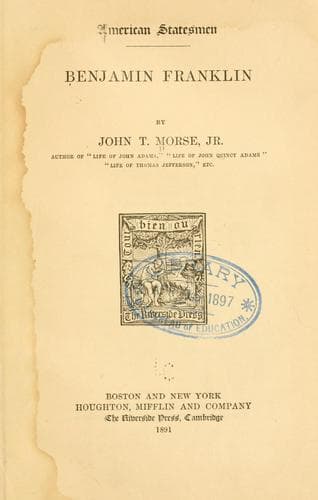
Benjamin FranklinMorse, John T., Jr. (John Torrey)
History
Benjamin Franklin
Morse, John T., Jr. (John Torrey)
Franklin, Benjamin, 1706-1790
Among illustrious Americans Franklin stands preeminent in the interest
which is aroused by a study of his character, his mind, and his career.
One becomes attached to him, bids him farewell with regret, and feels
that for such as he the longest span of life is all too short. Even
though dead, he attracts a personal regard which renders easily
intelligible the profound affection which so many men felt for him while
living. It may be doubted whether any one man ever had so many, such
constant, and such firm friends as in three different nations formed
about him a veritable host. In the States and in France he was loved,
and as he grew into old age he was revered, not by those who heard of
him only, but most warmly by those who best knew him. Even in England,
where for years he was the arch-rebel of all America, he was generally
held in respect and esteem, and had many constant friends whose
confidence no events could shake. It is true, of course, that he had
also his detractors, with most of whom the reader has already made
acquaintance. In Pennsylvania the proprietary party cherished an
animosity which still survives against his memory, but which does not
extend far beyond those who take it as an inheritance. It does him no
discredit with persons who understand its source. In New England a
loyalty to those famous New Englanders, John Adams and Samuel Adams,
seems to involve in the minds of some persons a depreciation of
Franklin. In English historical literature the patriotic instinct
stands in the way of giving Franklin quite his full due of praise. But
the faults and defects of character and conduct which are urged against
him appear little more than the expression of personal ill will, when
they are compared with the affection and the admiration given to him in
liberal measure by the great mass of mankind both in the generations
which knew him as a living contemporary and in those which hear of him
only as one of the figures of history. It is not worth while to deify
him, or to speak with extravagant reverence, as if he had neither faults
nor limitations. Yet it seems ungracious to recall these concerning one
who did for his fellow men so much as Franklin did. Moral, intellectual,
and material boons he conferred in such abundance that few such
benefactors of the race can be named, though one should survey all the
ages. A man of a greater humanity never lived; and the quality which
stood Abou Ben Adhem in good stead should suffice to save Franklin from
human criticism. He not only loved his kind, but he also trusted them
with an implicit confidence, reassuring if not extraordinary in an
observer of his shrewdness and experience. Democrats of the
revolutionary school in France and of the Jeffersonian school in the
United States have preached an exaggerated gospel of the people, but
their words are the dubious ones of fanatics or politicians. Franklin
was of a different kind, and had a more genuine and more generous faith
Public-domain text, read in full here on John Shaqi.
Reviews
Reviews
No reviews yet
Be the first to share your thoughts on this work.
Elsewhere in the archive
Join the Discussion
Join the discussion
Sign in to leave a comment or review.
Sign InorCreate an account