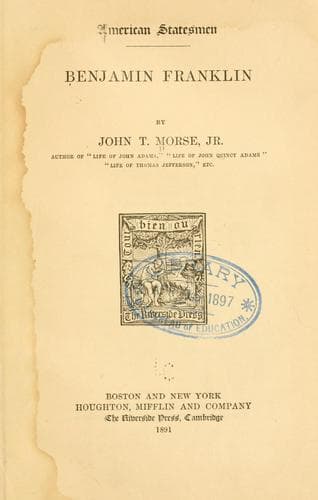
Benjamin FranklinMorse, John T., Jr. (John Torrey)
History
Benjamin Franklin
Morse, John T., Jr. (John Torrey)
Franklin, Benjamin, 1706-1790
in man than the greatest democrat in politics who ever lived.
Franklin's inborn ambition was the noblest of all ambitions: to be of
practical use to the multitude of men. The chief motive of his life was
to promote the welfare of mankind. Every moment which he could snatch
from enforced occupations was devoted to doing, devising, or suggesting
something advantageous more or less generally to men. His detractors
have given a bad, but also a false coloring to this trait. They say that
the spirit of all that he did and taught was sordid, that the motives
and purposes which he set before men were selfish, that his messages
spoken through the mouth of Poor Richard inculcated no higher objects in
life than money-getting. This is an utterly unfair form of stating the
case. Franklin was a great moralist: though he did not believe in the
Christian religion according to the straitlaced orthodox view, he
believed in the virtues which that religion embodies; and he was not
only often a zealous preacher, but in the main a consistent exemplar of
them. Perhaps he did not rest them upon precisely the same basis upon
which the Christian preacher does, but at least he put them on a basis
upon which they could stand firm. In such matters, however, one may
easily make mistakes, breed ill blood, and do harm; and his wisdom and
good sense soon led him to put forth his chief efforts and to display
especial earnestness and constancy in promoting the well-being of all
men. It was an object sufficiently noble, one would think, worthy of the
greatest brain and the largest heart, and having certain very
commendable traits in the way of practicability and substantial
possibilities. His desire was to see the community prosperous,
comfortable, happy, advancing in the accumulation of money and of all
physical goods, but not to the point of luxury; it was by no means the
pile of dollars which was his end, and he did not care to see many men
rich, but rather to see all men well to do. He was perfectly right in
thinking that virtuous living has the best prospects in a well-to-do
society. He gave liberally of his own means and induced others to give,
and promoted in proportion to the ability of the community a surprising
number of public and quasi public enterprises; and always the fireside
of the poor man was as much in his thought as the benefit of the richer
circle. Fair dealing and kindliness, prudence and economy in order to
procure the comforts and simpler luxuries of life, reading and knowledge
for those uses which wisdom subserves, constituted the real essence of
his teaching. His inventive genius was ever at work devising methods of
making daily life more agreeable, comfortable, and wholesome for all who
have to live. In a word, the service of his fellow men was his constant
aim; and he so served them that those public official functions which
are euphemistically called "public services" seemed in his case almost
Public-domain text, read in full here on John Shaqi.
Reviews
Reviews
No reviews yet
Be the first to share your thoughts on this work.
Elsewhere in the archive
Join the Discussion
Join the discussion
Sign in to leave a comment or review.
Sign InorCreate an account