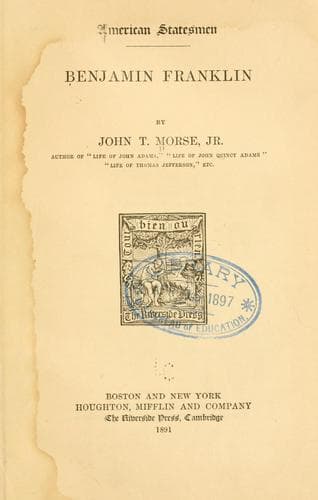
Benjamin FranklinMorse, John T., Jr. (John Torrey)
History
Benjamin Franklin
Morse, John T., Jr. (John Torrey)
Franklin, Benjamin, 1706-1790
Prisoners, exchange of, difficulties attending, 252, 253;
hardships of American prisoners, 253, 254, 255;
refusal of British to consider them prisoners of war, 254;
efforts of Franklin to secure this recognition, 255-264;
correspondence with Hartley, 256-262;
proposes exchange "on account," 258, 260;
final success, 262, 263;
refusal to exchange privateer prisoners, 263;
retaliation suggested, 263.
Privateers, their feats in English waters, 248, 249;
protected and commissioned by Franklin, 250, 252.
Prussia, treaty with, signed by Franklin, 397.
Pulteney, William, visits Franklin with a view to peace, 357.
Ralph, James, 9.
Rayneval, F. M. G. de, secretary to Vergennes, 375;
argues with Jay against American claims to Western lands, 375;
secret journey to London, 375.
Representation in Parliament, colonial, proposed by Shirley, 48;
by others, 127, 128;
views of Franklin, 48, 49, 128, 129.
Robertson, Dr., 75.
Rockingham, Marquis of, prime minister, 115;
decides to repeal Stamp Act, 118;
on importance of Franklin's arrival in France, 234;
forms cabinet after Yorktown, 365;
death, 372.
"Rules for reducing a great empire to a small one," 136;
condemned by Mansfield, 136, 137.
Rutledge, Edward, on committee to treat with Lord Howe, 214, 215, 216.
Sandwich, Lord, attacks Franklin in House of Lords, 198.
Saville, Sir George, friendly to America, 282.
Shelburne, Earl of, friendly to America, 147;
administers colonial affairs, 147;
hampered by Townshend, 148;
and hated by George III., 148, 149;
superseded by Hillsborough, 151;
protects Austin, 271;
timely letter of Franklin to, 365;
enters Rockingham cabinet, 365;
sends Oswald to Franklin, 365;
unwilling to admit independence of colonies, 367;
idea of a federal union, 367;
difficulties with Fox, 366, 370, 372;
becomes prime minister, 372;
assures Franklin of continuation of previous policy toward America, 372;
issues vague commission to Oswald, 372;
appealed to by Jay not to be led by Vergennes, 376;
his liberal views, 376;
gives new commission, 376;
his anxiety over the concession, 377;
earnest in behalf of Tories, 381, 382;
finally yields, 382;
condemned in England and loses office, 383.
Shirley, governor of Massachusetts, proposes scheme of colonial union, 46;
discussion with Franklin, 47-49;
appoints auditors for claims under Braddock's expedition, 54;
his success as a soldier explained by Franklin, 56.
Sieyes, M., 419.
Spain, secretly aids Beaumarchais, 229;
aid asked in recognizing United States, 274, 275, 279;
gives slight financial aid, 307, 317, 321;
interests in America threaten to prolong war, 369;
or divide France and States, 370;
tries to prevent States gaining Western lands, 380.
Public-domain text, read in full here on John Shaqi.
Reviews
Reviews
No reviews yet
Be the first to share your thoughts on this work.
Elsewhere in the archive
Join the Discussion
Join the discussion
Sign in to leave a comment or review.
Sign InorCreate an account