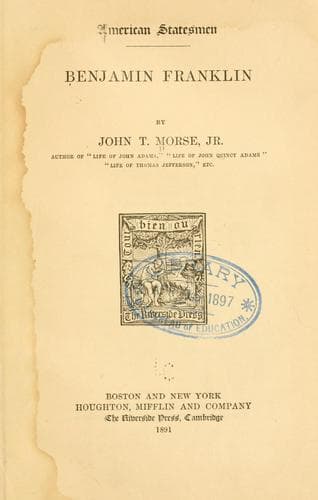
Benjamin FranklinMorse, John T., Jr. (John Torrey)
History
Benjamin Franklin
Morse, John T., Jr. (John Torrey)
Franklin, Benjamin, 1706-1790
advantage in carrying through his public and quasi public measures. Thus
he anticipated more powerful mechanisms of the like kind, such as the
Jacobin Club; and he himself, under encouraging circumstances, might
have wielded an immense power as the creator and occult, inspiring
influence of some great political society.
[Note 4: Parton's _Life of Franklin_, i. 47.]
Besides his didactic newspaper, his almanac even more didactic, the
Junto, the subscription library, the Society of the Free and Easy, his
system of religion and morals, and his scheme for acquiring all the
virtues, Franklin was engaged in many other matters. He learned French,
Italian, and Spanish; and in so doing evolved some notions which are now
beginning to find their way into the system of teaching languages in our
schools and colleges. In 1736 he was chosen clerk to the General
Assembly, and continued to be reelected during the next fourteen years,
until he was chosen a member of the legislature itself. In 1737 he was
appointed postmaster of Philadelphia, an office which he found "of great
advantage, for, tho' the salary was small, it facilitated the
correspondence that improv'd my newspaper, increased the number
demanded, as well as the advertisements to be inserted, so that it came
to afford me a considerable income. My old competitor's newspaper
declined proportionably, and I was satisfied without retaliating his
refusal, while postmaster, to permit my papers being carried by the
riders."
Soon afterward he conferred a signal benefit on his countrymen by
inventing an "open stove for the better warming of rooms, and at the
same time saving fuel,"--the Franklin stove, or, as he called it, "the
Pennsylvania fireplace." Mr. Parton warmly describes it as the beginning
of "the American stove system, one of the wonders of the industrial
world." Franklin refused to take out a patent for it, "from a principle
which has ever weighed with me on such occasions, viz.: That as we enjoy
great advantages from the inventions of others, we should be glad of an
opportunity to serve others by any invention of ours; and this we should
do freely and generously." This lofty sentiment, wherein the
philanthropist got the better of the man of business, overshot its mark;
an ironmonger of London, who did not combine philosophy and philanthropy
with his trade, made "some small changes in the machine, which rather
hurt its operation, got a patent for it there, and made a little fortune
by it."
Public-domain text, read in full here on John Shaqi.
Reviews
Reviews
No reviews yet
Be the first to share your thoughts on this work.
Join the Discussion
Join the discussion
Sign in to leave a comment or review.
Sign InorCreate an account