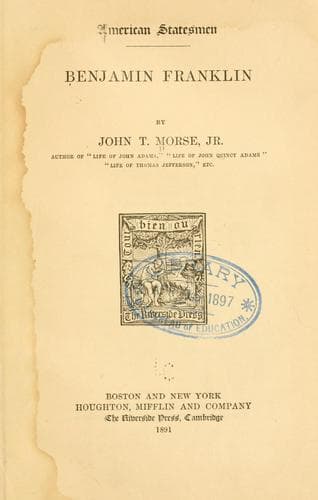
Benjamin FranklinMorse, John T., Jr. (John Torrey)
History
Benjamin Franklin
Morse, John T., Jr. (John Torrey)
Franklin, Benjamin, 1706-1790
An interesting page in the autobiography concerns events in the year
1754. There were distinct foreshadowings of that war between England and
France which soon afterward broke out, beginning upon this side of the
water earlier than in Europe; and the lords of trade ordered a congress
of commissioners from the several colonies to assemble at Albany for a
conference with the chiefs of the Six Nations. They came together June
19, 1754. Franklin was a deputy from Pennsylvania; and on his way
thither he "projected and drew a plan for the union of all the colonies
under one government, so far as might be necessary for defense and other
important general purposes." It was not altogether a new idea; in 1697
William Penn had suggested a commercial union and an annual congress.
The journal of the congress shows that on June 24 it was unanimously
voted that a union of the colonies was "absolutely necessary for their
security and defense." The Massachusetts delegation alone had been
authorized to consider the question of a union, and they had power to
enter into a confederation "as well in time of peace as of war."
Franklin had already been urging this policy by writings in the
"Gazette," and now, when the ideas of the different commissioners were
brought into comparison, his were deemed the best. His outline of a
scheme, he says, "happen'd to be preferr'd," and, with a few amendments,
was accordingly reported. It was a league rather than a union, somewhat
resembling the arrangement which came into existence for the purposes of
the Revolution. But it came to nothing; "its fate," Franklin said, "was
singular." It was closely debated, article by article, and having at
length been "pretty unanimously accepted, it came before the colonial
assemblies for ratification." But they condemned it; "there was too much
prerogative in it," they thought. On the other hand, the board of trade
in England would not approve it because it had "too much of the
democratic." All which led Franklin to "suspect that it was really the
true medium." He himself acknowledged that one main advantage of it
would be "that the colonies would, by this connection, learn to consider
themselves, not as so many independent states, but as members of the
same body; and thence be more ready to afford assistance and support to
each other," etc. It was already the _national idea_ which lay, not
quite formulated, yet distinct enough in his mind. It was hardly to be
expected that the home government would fail to see this tendency, or
that they would look upon it with favor. Franklin long afterward
indulged in some speculations as to what might have been the
consequences of an adoption of his scheme, namely: united colonies,
strong enough to defend themselves against the Canadian French and
their Indian allies; no need, therefore, of troops from England; no
pretext, therefore, for taxing the provinces; no provocation, therefore,
for rebellion. "But such mistakes are not new; history is full of the
Public-domain text, read in full here on John Shaqi.
Reviews
Reviews
No reviews yet
Be the first to share your thoughts on this work.
Join the Discussion
Join the discussion
Sign in to leave a comment or review.
Sign InorCreate an account