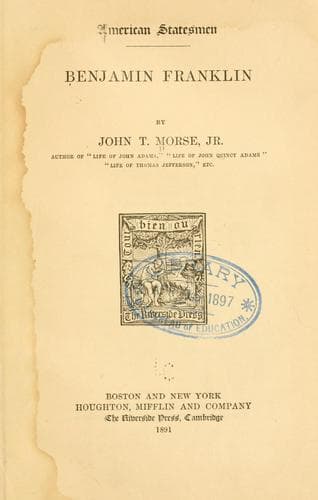
Benjamin FranklinMorse, John T., Jr. (John Torrey)
History
Benjamin Franklin
Morse, John T., Jr. (John Torrey)
Franklin, Benjamin, 1706-1790
humor: "and, indeed, I have since learnt that immense fortunes are often
made in such employments." Those, however, were simple, provincial days.
In place of the money which he did not get, also of the further sum
which he actually lost, he had to satisfy himself with the consolation
derived from the approbation of the Pennsylvania Assembly, while also
Braddock's dispatches gave him a good name with the officials in
England, which was of some little service to him.
A more comical result of the Braddock affair was that it made Franklin
for a time a military man and a colonel. He had escaped being a
clergyman and a poet, but he could not escape that common fate of
Americans, the military title, the prevalence of which, it has been
said, makes "the whole country seem a retreat of heroes." It befell
Franklin in this wise: immediately after Braddock's defeat, in the panic
which possessed the people and amid the reaction against professional
soldiers, recourse was had to plain good sense, though unaccompanied by
technical knowledge. No one, as all the province knew, had such sound
sense as Franklin, who was accordingly deputed to go to the western
frontier with a small volunteer force, there to build three forts for
the protection of the outlying settlements. "I undertook," he says,
"this military business, though I did not conceive myself well qualified
for it." It was a service involving much difficulty and hardship, with
some danger; General Braddock would have made a ridiculous failure of
it; Franklin acquitted himself well. What he afterward wrote of General
Shirley was true of himself: "For, tho' Shirley was not bred a soldier,
he was sensible and sagacious in himself, and attentive to good advice
from others, capable of forming judicious plans, and quick and active in
carrying them into execution." In a word, Franklin's military career was
as creditable as it was brief. He was called forward at the crisis of
universal dismay; he gave his popular influence and cool head to a
peculiar kind of service, of which he knew much by hearsay, if nothing
by personal experience; he did his work well; and, much stranger to
relate, he escaped the delusion that he was a soldier. So soon as he
could do so, that is to say after a few weeks, he returned to his civil
duties. But he had shown courage, intelligence, and patriotism in a high
degree, and he had greatly increased the confidence reposed in him by
his fellow citizens.
Public-domain text, read in full here on John Shaqi.
Reviews
Reviews
No reviews yet
Be the first to share your thoughts on this work.
Join the Discussion
Join the discussion
Sign in to leave a comment or review.
Sign InorCreate an account