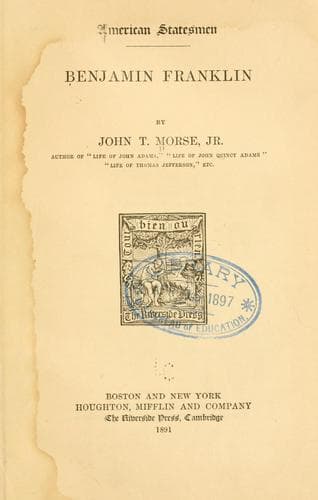
Benjamin FranklinMorse, John T., Jr. (John Torrey)
History
Benjamin Franklin
Morse, John T., Jr. (John Torrey)
Franklin, Benjamin, 1706-1790
Next came an interview with the proprietaries. Each side declared itself
disposed towards "reasonable accommodations;" but Franklin supposed that
"each party had its own ideas of what should be meant by _reasonable_."
Nothing came of all this palaver; which only meant that time was being
wasted to no better purpose than to show that the two parties were "very
wide, and so far from each other in [their] opinions as to discourage
all hope of agreement." But this had long been evident. The lawyer of
the proprietaries was then put forward. He was a "proud, angry man,"
with a "mortal enmity" toward Franklin; for the two had exchanged
buffets more than once already, and the "proud angry man" had been hit
hard. It had been his professional duty, as counsel for the Penns, to
prepare many papers to be used by their governor in the course of their
quarrels with the Assembly. It had usually fallen to Franklin's lot to
draft the replies of the Assembly, and by Franklin's own admission these
documents of his, like those which they answered, were "often tart and
sometimes indecently abusive." Franklin now found his old antagonist so
excited that it seemed best to refuse to have any direct dealings with
him.
The proprietaries then put their interests in charge of Attorney-General
Pratt, afterwards Lord Camden, and the Solicitor-General Charles Yorke,
afterward lord chancellor. These legal luminaries consumed "a year,
wanting eight days" before they were in a condition to impart light; and
during that period Franklin could of course achieve nothing with the
proprietaries. After all, the proprietaries ignored and insulted him,
and made further delay by sending a message to the Assembly of
Pennsylvania, wherein they complained of Franklin's "rudeness," and
professed themselves "willing to accommodate matters," if a "person of
candour" should be sent to treat with them. The only reply to their
message came in the pointed and intelligible shape of an act "taxing the
proprietary estate in common with the estates of the people." Much
disturbed, the proprietaries now obtained a hearing before the king in
council. They requested his majesty to set aside this tax act, and
several other acts which had been passed within two years by the
Assembly. Of these other acts some were repealed, according to the
prayer of the proprietaries; but more were allowed to stand. These were,
however, of comparatively little consequence; the overshadowing
grievance for the Penns lay in this taxation of their property.
Concerning this it was urged by their counsel that the proprietaries
were held in such odium by the people that, if left to the popular
"mercy in apportioning the taxes, they would be ruined." The other side,
of course, vehemently denied that there was the slightest ground for
such a suspicion.
Public-domain text, read in full here on John Shaqi.
Reviews
Reviews
No reviews yet
Be the first to share your thoughts on this work.
Join the Discussion
Join the discussion
Sign in to leave a comment or review.
Sign InorCreate an account