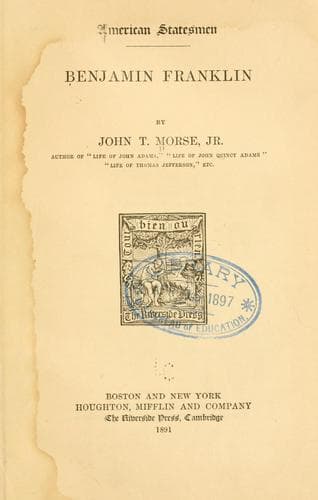
Benjamin FranklinMorse, John T., Jr. (John Torrey)
History
Benjamin Franklin
Morse, John T., Jr. (John Torrey)
Franklin, Benjamin, 1706-1790
"But if he cannot on these considerations quite excuse the
Assembly, what will he think of those honourable proprietaries,
who, when paper money was issued in their colony for the _common
defense_ of their vast estates with those of the people, could
nevertheless wish to be exempted from their share of the
unavoidable disadvantages. Is there upon earth a man besides, with
any conception of what is honest, with any notion of honor, with
the least tincture in his veins of the gentleman, but would have
blushed at the thought, but would have rejected with disdain such
undue preference, if it had been offered him? Much less would he
have struggled for it, moved heaven and earth to obtain it,
resolved to ruin thousands of his tenants by a repeal of the act,
rather than miss of it, and enforce it afterwards by an
audaciously wicked instruction, forbidding aids to his king, and
exposing the province to destruction, unless it was complied with.
And yet, these are honourable men!"
This was, however, altogether a subordinate issue. The struggle had
really been conducted to determine whether the proprietary estate should
be taxed like other estates, and the decision upheld such taxation. This
was a complete triumph for the Assembly and their representative. "But
let the proprietaries and their discreet deputies hereafter recollect
and remember," said Franklin, "that the same august tribunal, which
censured some of the modes and circumstances of that act, did at the
same time establish and confirm the grand principle of the act, namely:
'That the proprietary estate ought, with other estates, to be taxed;'
and thereby did, in effect, determine and pronounce that the opposition
so long made in various shapes to that just principle, by the
proprietaries, was 'fundamentally _wrong_ and _unjust_!'"
It was a long while before the Assembly found leisure to attend to that
engagement of their agents which stipulated for an investigation to see
whether the proprietaries had not been unduly and excessively assessed.
But at length, after having had the spur of reminder constantly applied
to their laggard memories, they appointed a committee to inquire and
report concerning the valuations made by the tax-gatherers.
This committee reported that--
"there has not been any injustice done to the proprietaries, or
attempts made to rate or assess any part of their estates higher
than the estates of the like kind belonging to the inhabitants are
rated and assessed; but, on the contrary, ... their estates are
rated, in many instances, below others."
So the matter ended.
Public-domain text, read in full here on John Shaqi.
Reviews
Reviews
No reviews yet
Be the first to share your thoughts on this work.
Join the Discussion
Join the discussion
Sign in to leave a comment or review.
Sign InorCreate an account