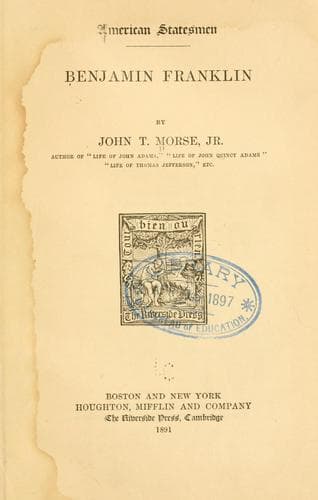
Benjamin FranklinMorse, John T., Jr. (John Torrey)
History
Benjamin Franklin
Morse, John T., Jr. (John Torrey)
Franklin, Benjamin, 1706-1790
The third group follows the overthrow of Federalism with its theory of a
strongly centralized government. This, of course, begins with Thomas
Jefferson, who led and organized the new party of the democracy. He is
followed by his political disciple, James Madison; by their secretary of
the treasury, Albert Gallatin; and by James Monroe, John Quincy Adams,
and John Randolph. The two last named are hardly to be called
Jeffersonians, but they mark the passage of the nation from the
statesmanship of Jefferson to the widely different democracy of Jackson.
The fourth group witnesses the absorption of the nation in questions of
domestic policy. The crude and rough domination of Andrew Jackson opened
a new order of things. Men's minds were busied with affairs at home, at
first more especially with the tariff, then more and more exclusively
with slavery. This group, besides Jackson, includes Martin Van Buren,
Henry Clay, Daniel Webster, John C. Calhoun, Thomas H. Benton, and Lewis
Cass.
The fifth and closing group is that of the civil war. This of course
opens with Abraham Lincoln. The others are William H. Seward, as being a
sort of prime minister throughout the period; Salmon P. Chase, in whose
life can properly be discussed the financial policy and the principal
legal matters; Charles Francis Adams, embodying the important topic of
diplomatic relations; Charles Sumner, representing the advanced
abolitionist element; and Thaddeus Stevens, who appears as a tribune,
perhaps we may say the leader, in the popular branch of Congress.
Almost inevitably the series begins with Benjamin Franklin, the first
great American, the first man born on this side of the water who was
"meant for the universe." His mere existence was a sort of omen. It was
absurd to suppose that a people which could produce a man of that scope,
in character and intellect, could long remain in a condition of
political dependence. It would have been preposterous to have had
Franklin die a colonist, and go down to posterity, not as an American,
but as a colonial Englishman. He was a microcosm of the coming nation of
the United States; all the better moral and intellectual qualities of
our people existed in him, save only the dreamy philosophy of the famous
New England school of thinkers. It is very interesting to see how slowly
and reluctantly, yet how surely and decisively, he came to the point of
resistance and independence. He was not like so many, who were unstable
and shifting. There was no backward step, though there were many painful
and unwilling forward ones in his progress. One feels almost as if an
apology were needed for writing another life of a man so be-written. Yet
there is some reason for doing so; the chapter concerning his services
in France during the Revolution presents the true facts and the
magnitude of his usefulness more carefully than, so far as I am aware,
it has previously been done.
Public-domain text, read in full here on John Shaqi.
Reviews
Reviews
No reviews yet
Be the first to share your thoughts on this work.
Join the Discussion
Join the discussion
Sign in to leave a comment or review.
Sign InorCreate an account