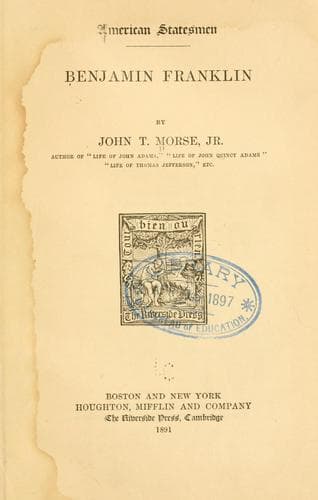
Benjamin FranklinMorse, John T., Jr. (John Torrey)
History
Benjamin Franklin
Morse, John T., Jr. (John Torrey)
Franklin, Benjamin, 1706-1790
Franklin himself also was trying his hand at match-making. He had taken
a great fancy to a young lady by the name of Mary Stevenson, with whom,
when distance prevented their meeting, he kept up a constant
correspondence concerning points of physical science. He now became very
pressing with his son William to wed this learned maiden; but the young
man possibly did not hold a taste for science to be the most winning
trait in woman; at any rate, having bestowed his affections elsewhere,
he refused to transfer them. So Franklin was compelled to give up his
scheme, though with an extreme reluctance, which he expressed to the
rejected damsel with amusing openness. Had either of these matrimonial
bonds been made fast, it is not improbable that Franklin would have
lived out the rest of his life as a friend of the colonies in England.
But his lot was otherwise cast; a second time he escaped, though
narrowly, the prospect of dying an Englishman and the subject of a king.
At the moment he was not altogether glad that matters worked thus. On
August 17, 1762, he wrote from Portsmouth to Lord Kames:--
"I am now waiting here only for a wind to waft me to America; but
cannot leave this happy island and my friends in it without extreme
regret, though I am going to a country and a people that I love. I
am going from the old world to the new; and I fancy I feel like
those who are leaving this world for the next: grief at the
parting; fear of the passage; hope of the future. These different
passions all affect their minds at once; and these have _tendered_
me down exceedingly."
And six days later, from the same place, he wrote to Strahan: "I cannot,
I assure you, quit even this disagreeable place, without regret, as it
carries me still farther from those I love, and from the opportunities
of hearing of their welfare. The attraction of reason is at present for
the other side of the water, but that of inclination will be for this
side. You know which usually prevails. I shall probably make but this
one vibration and settle here forever. Nothing will prevent it, if I
can, as I hope I can, prevail with Mrs. F. to accompany me, especially
if we have a peace." Apparently the Americans owe a great debt of
gratitude to Mrs. Franklin's fearfulness of the untrustworthy Atlantic.
Public-domain text, read in full here on John Shaqi.
Reviews
Reviews
No reviews yet
Be the first to share your thoughts on this work.
Join the Discussion
Join the discussion
Sign in to leave a comment or review.
Sign InorCreate an account