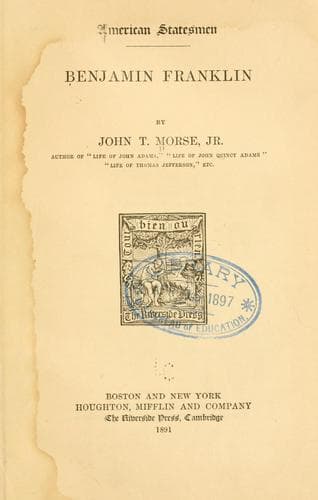
Benjamin FranklinMorse, John T., Jr. (John Torrey)
History
Benjamin Franklin
Morse, John T., Jr. (John Torrey)
Franklin, Benjamin, 1706-1790
Franklin came to England in the anticipation of a short stay, and with
no purpose beyond the presentation and urging of the petition for the
change of government. Somewhat less than ten months, he thought, would
suffice to finish this business. In fact, he did not get home for ten
years, and this especial errand, which had seemed all that he had to do,
soon sank into such comparative insignificance that, though not
actually forgotten, it could not secure attention. He conscientiously
made repeated efforts to keep the petition in the memory of the English
ministry, and to obtain action upon it; but his efforts were vain; that
body was absorbed by other affairs in connection with the troublesome
American colonies,--affairs which gave vastly more perplexity and called
for much more attention than were becoming in the case of provinces that
should have been submissive as well-behaved children. Franklin himself
found his own functions correspondingly enlarged. Instead of remaining
simply an agent charged with urging a petition which brought him in
conflict only with private persons, like himself subjects of the king,
he found his position rapidly change and develop until he became really
the representative of a disaffected people maintaining a cause against
the monarch and the government of the great British Empire. It was the
"Stamp Act" which effected this transformation.
Scarcely had the great war with France been brought to a close by the
treaty of 1763, bringing such enormous advantages to the old British
possessions in America, before it became apparent that among the fruits
some were mingled that were neither sweet nor nourishing. The war had
moved the colonies into a perilous foreground. Their interests had cost
much in men and money, and had been worth all that they had cost, and
more; the benefits conferred upon them had been immense, yet were
recognized as not being in excess of their real importance, present and
future. Worst of all, the magnitude of their financial resources had
been made apparent; without a murmur, without visible injury to their
prosperity, they had voluntarily raised large sums by taxation.
Meanwhile the English treasury had been put to enormous charges, and the
English people groaned beneath the unwonted tax burdens which they had
to bear. The attention of British financiers, even before the war was
over, was turned toward the colonies, as a field of which the productive
capacity had never been developed.
Public-domain text, read in full here on John Shaqi.
Reviews
Reviews
No reviews yet
Be the first to share your thoughts on this work.
Join the Discussion
Join the discussion
Sign in to leave a comment or review.
Sign InorCreate an account