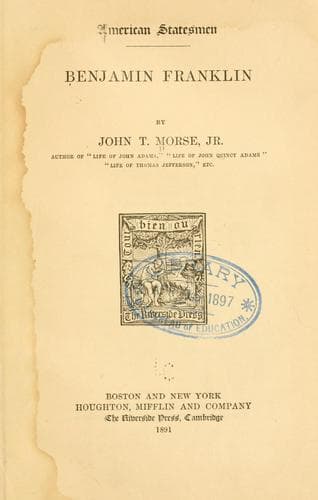
Benjamin FranklinMorse, John T., Jr. (John Torrey)
History
Benjamin Franklin
Morse, John T., Jr. (John Torrey)
Franklin, Benjamin, 1706-1790
certainly expressed ill feeling towards it; but Grenville silenced them,
telling them that he was acting "from a real regard and tenderness"
towards the Americans. He said this in perfect good faith. His views
both of the law and of the reasons for the law were intelligent and
honest; he had carefully gathered information and sought advice; and he
had a profound belief alike in the righteousness and the wisdom of the
measure.
[Note 17: Bancroft, _Hist. U. S._ iv. 155.]
News of what was in preparation in England reached Pennsylvania in the
summer of 1764, shortly before Franklin sailed. The Assembly debated
concerning it; Franklin was prominent in condemning the scheme; and a
resolution protesting against it was passed. It was made part of
Franklin's duty in London to urge upon Grenville these views of
Pennsylvania. But when he arrived he found that the grinding at the
mills of government was going on much too evenly to be disturbed by the
introduction of any such insignificant foreign substance as a colonial
protest. Nevertheless he endeavored to do what he could. In company with
three other colonial agents he had an interview with Grenville, February
2, 1765, in which he urged that taxation by act of Parliament was
needless, inasmuch as any requisition for the service of the king always
had found, and always would find, a prompt and liberal response on the
part of the Assembly. Arguments, however, and protests struck
ineffectually against the solid wall of Grenville's established purpose.
He listened with a civil appearance of interest and dismissed his
visitors and all memory of their arguments together. On the 13th of the
same month he read the bill in Parliament; on the 27th it passed the
Commons; on March 8, the Lords; and on March 22 it was signed by a royal
commission; the insanity of the king saved him from placing his own
signature to the ill-starred law. In July Franklin wrote to Charles
Thomson:--
"Depend upon it, my good neighbor, I took every step in my power to
prevent the passing of the Stamp Act. Nobody could be more
concerned and interested than myself to oppose it sincerely and
heartily. But the tide was too strong against us. The nation was
provoked by American claims of independence, and all parties joined
in resolving by this act to settle the point. We might as well have
hindered the sun's setting. That we could not do. But since it is
down, my friend, and it may be long before it rises again, let us
make as good a night of it as we can. We can still light candles.
Frugality and industry will go a great way towards indemnifying us.
Idleness and pride tax with a heavier hand than kings and
parliaments. If we can get rid of the former, we may easily bear
the latter."
Public-domain text, read in full here on John Shaqi.
Reviews
Reviews
No reviews yet
Be the first to share your thoughts on this work.
Join the Discussion
Join the discussion
Sign in to leave a comment or review.
Sign InorCreate an account