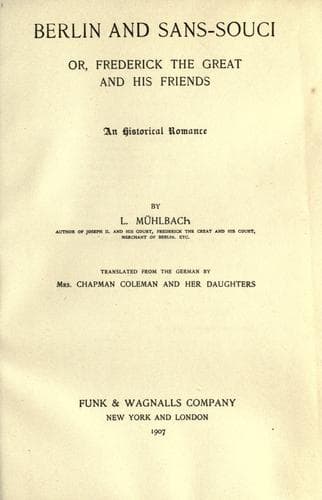
Berlin and Sans-Souci; Or, Frederick the Great and His FriendsMühlbach, L. (Luise)
History
Berlin and Sans-Souci; Or, Frederick the Great and His Friends
Mühlbach, L. (Luise)
Frederick II, King of Prussia, 1712-1786 -- Fiction; Prussia (Germany) -- History -- Frederick II, 1740-1786 -- Fiction
"Agreed," said Pollnitz, and he sprang with youthful elasticity from
the divan and joined Fredersdorf at the window. They listened almost
breathlessly to the sweet tones which seemed to whisper to them from
the upper windows; then mingling and melting with the perfume of the
orange-blossoms and the glorious and life-giving morning air, they
forced their sweet and subtle essence into the room with the cunning
and hardened old courtiers.
Fredersdorf and Pollnitz listened as a sly bat listens to the merry
whistling of an innocent bird, and watches the propitious moment to
spring upon her prey. It was an adagio which the king played upon
his flute, and he was indeed a master in the art. Slightly
trembling, as if in eternal melancholy, sobbing and pleading, soon
bursting out in rapturous and joyful strains of harmony, again
sighing and weeping, these melting tones fell like costly pearls
upon the summer air. The birds in the odorous bushes, the wind which
rustled in the trees, the light waves of the river, which with soft
murmurs prattled upon the shore, all Nature seemed for the moment to
hold her breath and listen to this enchanting melody. Even
Fredersdorf felt the power and influence of this music as he had
done in earlier days. The old love for his king filled his heart,
and his eyes were misty with tears.
As the music ceased, Fredersdorf exclaimed involuntarily: "He is,
after all, the noblest and greatest of men. It is useless to be
angry with him. I am forced against my will to worship him."
"Now," said Pollnitz, whose face had not for one moment lost its
expression of cold attention and sly cunning, "how says the
barometer? May we promise ourselves a clear and sunny day?"
"Yes, Frederick is in one of his soft and yielding moods. It is
probable he has been some hours awake and has written to some of his
friends--perhaps to Voltaire, or Algarotti; this makes him always
bright and clear."
"You think I shall obtain my audience?"
"I think you will."
"Then, dear friend, I have only to say that I hope you will give me
the chocolate for that noble and soul-searching hound, the Signora
Biche."
CHAPTER III.
THE MORNING HOURS OF A KING.
King Frederick had finished the adagio, and stood leaning against
the window gazing into the garden; his eyes, usually so fierce and
commanding, were softened by melancholy, and a sad smile played upon
his lips. The touching air which he had played found its echo
within, and held his soul a prisoner to troubled thoughts. Suddenly
he seemed to rouse himself by a great effort to the realities of
life, and, hastily ringing the bell, he commanded Jordan, the
director of the poor and the almshouse, to be summoned to him.
Public-domain text, read in full here on John Shaqi.
Reviews
Reviews
No reviews yet
Be the first to share your thoughts on this work.
Join the Discussion
Join the discussion
Sign in to leave a comment or review.
Sign InorCreate an account