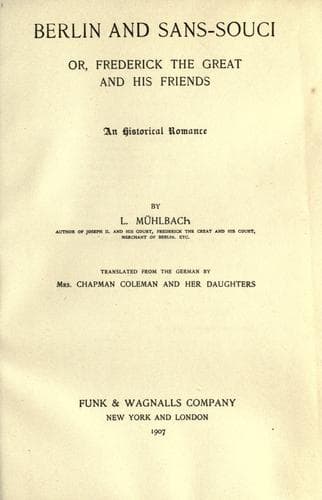
Berlin and Sans-Souci; Or, Frederick the Great and His FriendsMühlbach, L. (Luise)
History
Berlin and Sans-Souci; Or, Frederick the Great and His Friends
Mühlbach, L. (Luise)
Frederick II, King of Prussia, 1712-1786 -- Fiction; Prussia (Germany) -- History -- Frederick II, 1740-1786 -- Fiction
The king had given her no occasion to complain of his love for
Barbarina; she did not know that he had ever approached her, even
spoken to her; she knew, however, with what looks and smiles of
rapture he gazed upon her, and she would joyfully have given her
life for one such glance or smile. That, however, which was not
known to Elizabeth, was fully understood by the whole court. It was
known that more than once the Barbarina had supped with the king at
the house of General Rothenberg; it was known that the king, every
time the Barbarina danced, was behind the curtain, and that, he had
commanded the court painter, Pesne, to paint her portrait, life
size, for him.
Was not this enough to exalt the signora in the eyes of every
courtier and every diplomatist to the first rank of beauty and
power? Would they not, indeed, have hastened to acknowledge her
claims, even had she not been the loveliest and most enchanting
creature? She was indeed a queen, a powerful enchantress. Men
struggled for one smile, one glance; they bowed down to all her
caprices and humors; worship, submission, and obedience were the
tribute brought by all. Her house was besieged with visits and
petitions as if it were the palace of a fairy queen. Barbarina had
her court circle, her levees, her retinue. [Footnote: Schneider,
"History of the Opera and Opera-Houses in Berlin."] All her subjects
rendered her a glad and voluntary service, and received no other
compensation than a gay smile or friendly word.
All this splendor, consideration, and worship, of which she was the
shining centre, seemed to make no impression upon the heart of the
proud and self-reliant artiste; she was accustomed to it, and moved
on in silent majesty; her whole life had been a triumphant march.
Like a summer morning glittering in the dew and sunshine, she had
had her little griefs and tears, but they resembled the dew-drops in
the flower-cups, shining for a moment like costly diamonds, then
kissed away by the sun. Barbarina wept when the king separated her
from her lover, Lord Stuart, and forced her to fulfil her contract
and come to Berlin. She wept no more. Was it because she was too
proud? or had the sun of royal favor kissed away her tears?
Public-domain text, read in full here on John Shaqi.
Reviews
Reviews
No reviews yet
Be the first to share your thoughts on this work.
Elsewhere in the archive
Join the Discussion
Join the discussion
Sign in to leave a comment or review.
Sign InorCreate an account