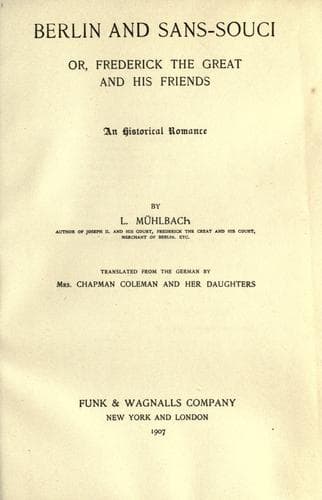
Berlin and Sans-Souci; Or, Frederick the Great and His FriendsMühlbach, L. (Luise)
History
Berlin and Sans-Souci; Or, Frederick the Great and His Friends
Mühlbach, L. (Luise)
Frederick II, King of Prussia, 1712-1786 -- Fiction; Prussia (Germany) -- History -- Frederick II, 1740-1786 -- Fiction
Barbarina's tears had ceased to flow, but she smiled rarely. She had
the grace and imposing beauty of the Roman, and never forgot that
she was a daughter of that proud nation who had ruled the world,
and, even though disenthroned, preserved her majesty and renown.
Barbarina was a glowing, passionate woman, and passion adorns itself
with flashing eyes, with a clear and touching pallor and crimson
lips, but never with the innocent smile and harmless jest. She was
never heard and rarely seen to laugh. Laughter was not in harmony
with her proud beauty, but smiles illuminated and glorified it. She
was imperial to look upon; but, filled with all sweet charity and
gentle grace, womanly and tender; with a full consciousness of her
power, she was humble and yielding. In the midst of her humility she
was proud, and sure of success and victory; one moment she was the
glowing, ardent, and yielding woman; the next the proud, genial,
imposing artiste. Such was Barbarina; an incomprehensible riddle,
unsearchable, unfathomable as the sea--ever changing, but great in
every aspect.
Barbarina had appeared the evening before, but her dance had been
interrupted by a sudden indisposition exactly at the moment when the
king appeared in the opera-house. No one knew that the king had
returned from his mysterious journey to Silesia; every one believed
him to be absent, and the ballet had been arranged without any
reference to him. Frederick arrived unexpectedly, and changing his
travelling-dress hastened to the opera, no doubt to greet the two
queens and his sisters. Barbarina was seized with indisposition at
the moment of the king's entrance. She floated smilingly and airily
over the stage; her small feet seemed borne by the Loves and Graces.
Suddenly she faltered, the smile vanished from her lips, and the
slight blush from her cheek, and with a cry of pain she sank
insensible upon the floor.
The curtain fell, and an intermission of a quarter of an hour was
announced. The king, who was conversing with the queen-mother,
appeared to take but little interest in this interruption, but Baron
Swartz approached and announced that Signora Barbarina was ill and
could not appear again during the evening. Frederick gave such an
angry exclamation, that the queen-mother looked up astonished and
questioning. Elizabeth Christine sighed and turned pale. She
comprehended the emotion of her husband; guided by the instinct of
jealousy, she read the king's alarm and disappointment, which he
tried in vain to hide under the mask of scorn.
"It appears to me," said the king, "that the signora is again
indulging in one of her proud and sullen moods, and refuses to dance
because I have returned. I will not submit to this caprice; I will
myself command her to dance."
Public-domain text, read in full here on John Shaqi.
Reviews
Reviews
No reviews yet
Be the first to share your thoughts on this work.
Elsewhere in the archive
Join the Discussion
Join the discussion
Sign in to leave a comment or review.
Sign InorCreate an account