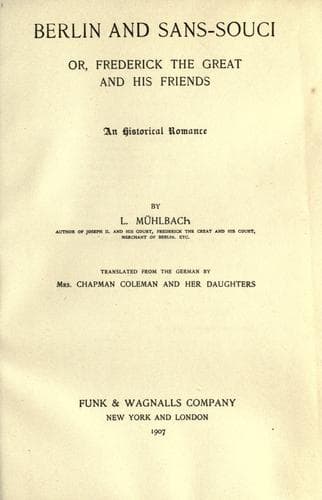
Berlin and Sans-Souci; Or, Frederick the Great and His FriendsMühlbach, L. (Luise)
History
Berlin and Sans-Souci; Or, Frederick the Great and His Friends
Mühlbach, L. (Luise)
Frederick II, King of Prussia, 1712-1786 -- Fiction; Prussia (Germany) -- History -- Frederick II, 1740-1786 -- Fiction
"You are most welcome in your double character," she said, in a
voice loud enough to be heard by the king and all around her. "Until
to-day, you have been my beloved brother; and from this time will
you be to me, as also to my husband, a dear son. By the decrees of
Providence a son has been denied me; I accept you, therefore,
joyfully, and receive you as my son and brother."
A profound silence followed these words; here and there in the
crowd, slight and derisive smiles were seen, and a few whispered and
significant words were uttered. The queen had now received the last
and severest blow; in the fulness and maturity of her beauty she had
been placed before the court as unworthy or incapable of giving a
successor to the throne; but she still wished to save appearances:
she would, if possible, make the world believe that the decree of
Providence alone denied to her a mother's honors. She had the cruel
courage to conceal the truth by prevarication.
The watchful eyes of the court had long since discovered the mystery
of this royal marriage: they had long known that the queen was not
the wife of Frederick; her words, therefore, produced contemptuous
surprise.
Elizabeth cared for none of these things. She looked toward her
husband, whose eyes were fixed upon her; she would read in his
countenance if he were pleased with her words. A smile played upon
the lips of the king, and he bowed his head almost imperceptibly as
a greeting to his wife.
A golden ray of sunlight seemed to play upon her face; content was
written in her eyes; twice to-day her glance had met her husband's,
and both times his eyes had spoken. Elizabeth was happier than she
had been for many days; she laughed and jested with the ladies, and
conversed gayly over the great event of the evening--the first
appearance of the Signora Barbarina. The princesses, also, conversed
unceremoniously with the ladies near them. A cloud darkened the
usually clear brow of the Princess Amelia, and she seemed to be in a
nervous and highly excited state.
At this moment the master of ceremonies, Pollnitz, drew near, with
Count Tessin, the Swedish ambassador. The princess immediately
assumed so scornful an expression, that even Pollnitz scarcely found
courage to present Count Tessin.
"Ah! you come from Sweden," said Amelia, immediately after the
presentation. "Sweden is a dark and gloomy country, and you have
indeed done well to save yourself, by taking refuge in our gay and
sunny clime."
The count was evidently wounded.
"Your royal highness calls this a refuge," said he; "you must, then,
think those to be pitied who dwell in my fatherland?"
"I do not feel it necessary to confide my views on that subject to
Count Tessin," said Amelia, with a short, rude laugh.
"Yes, sister, it is necessary," said Ulrica, with a magical smile,
"you must justify yourself to the count, for you have cast contempt
upon his country."
Public-domain text, read in full here on John Shaqi.
Reviews
Reviews
No reviews yet
Be the first to share your thoughts on this work.
Join the Discussion
Join the discussion
Sign in to leave a comment or review.
Sign InorCreate an account