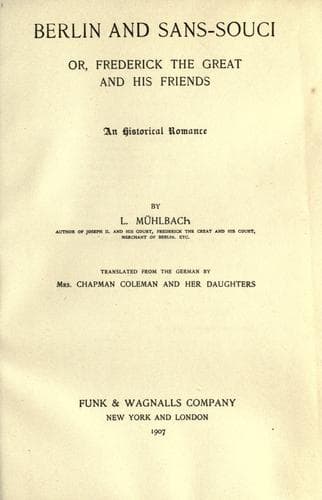
Berlin and Sans-Souci; Or, Frederick the Great and His FriendsMühlbach, L. (Luise)
History
Berlin and Sans-Souci; Or, Frederick the Great and His Friends
Mühlbach, L. (Luise)
Frederick II, King of Prussia, 1712-1786 -- Fiction; Prussia (Germany) -- History -- Frederick II, 1740-1786 -- Fiction
Pollnitz took the arm of the young officer and led him off, saying
to himself, with a chuckle: "That was a good stroke, and I feel that
I shall succeed; I have betrayed his passion to her, and forced
myself into their confidence. I shall soon be employed as Love's
messenger, and that is ever with princesses a profitable service.
Ah, King Frederick, King Frederick, you have made it impossible for
me to borrow money! Well, I shall not find that necessary; my hands
shall be filled from the royal treasures. When the casket of the
princess is empty, the king must of course replenish it." And the
baron laughed too loudly for a master of ceremonies.
CHAPTER VIII.
SIGNORA BARBARINA.
The princess regarded their retreating figures with dreamy eyes.
Then, yielding to an unconquerable desire to be alone, to give
herself up to undisturbed thought, she was about to withdraw; but
the Princess Ulrica, who thought it necessary that the Swedish
ambassador should have another opportunity of observing the proud
and sullen temper of her sister, called her back.
"Remain a moment longer, Amelia," said the princess. "You shall
decide between Count Tessin and myself. Will you accept my sister as
umpire, count?"
"Without doubt," said the count. "I should be greatly honored if the
princess will be so gracious. Perhaps I may be more fortunate on
this occasion."
"It appears to me," said Amelia, rudely interrupting him, "that
'fortunate' and 'unfortunate' are not terms which can be properly
used in any connection between a princess of Prussia and yourself."
Amelia then turned toward her sister and gave her a glance which
plainly said: Well, do I not play my role in masterly style? Have I
not hastened to follow your counsels? "Speak, sister; name the point
which Count Tessin dares to contest with you."
"Oh, the count is a man and a scholar, and has full right to
differ," said Ulrica, graciously. "The question was a comparison of
Queen Elizabeth of England and Queen Christina of Sweden. I maintain
that Christina had a stronger and more powerful intellect; that she
knew better how to conquer her spirit, to master her womanly
weaknesses; that she was more thoroughly cultivated, and studied
philosophy and science, not as Elizabeth, for glitter and show, but
because she had an inward thirst for knowledge. The count asserts
that Elizabeth was better versed in statecraft, and a more amiable
woman. Now, Amelia, to which of these two queens do you give the
preference?"
"Oh, without doubt, to Queen Christina of Sweden. This great woman
was wise enough not to regard the crown of Sweden as a rare and
precious gem; she chose a simple life of obscurity and poverty in
beautiful Italy, rather than a throne in cold and unfruitful Sweden.
This act alone establishes her superiority. Yes, sister, you are
right. Christina was the greater woman, even because she scorned to
be Queen of Sweden."
Public-domain text, read in full here on John Shaqi.
Reviews
Reviews
No reviews yet
Be the first to share your thoughts on this work.
Join the Discussion
Join the discussion
Sign in to leave a comment or review.
Sign InorCreate an account