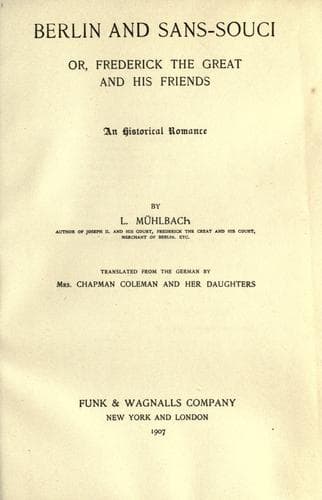
Berlin and Sans-Souci; Or, Frederick the Great and His FriendsMühlbach, L. (Luise)
History
Berlin and Sans-Souci; Or, Frederick the Great and His Friends
Mühlbach, L. (Luise)
Frederick II, King of Prussia, 1712-1786 -- Fiction; Prussia (Germany) -- History -- Frederick II, 1740-1786 -- Fiction
"Oh, I have had my experiences. I remember, that while I was
residing at the court of Saxony, I composed a poem in honor of the
Countess Aurora of Konigsmark. This was by special command of the
king; the poem was to be set to music by Hasse, and sung by the
Italian singers on the birthday of Aurora. Well, the Countess Aurora
was cast aside before my poem was finished, and the Countess Kozel
had taken her place. I finished my poem, but Amelia, and not Aurora,
was my heroine. Hasse composed the music, and no one who attended
the concert, given in honor of the birthday of the Countess Kozel,
had an idea that this festal cantata had been originally ordered for
Aurora of Konigsmark!
"Once, while I was in Russia, I had an audience from the Empress
Elizabeth. As I approached the castle, leaning on the arm of the
Captain Ischerbatow, I observed the guard, who stood before the
door, and presented arms. Well, eight weeks later, this common guard
was a general and a prince, and Isoherbatow was compelled to bow
before him!
"I saw in Venice a picture of the day of judgment by Tintoretto. In
this picture both Paradise and Hell were portrayed. I saw in
Paradise a lovely woman glowing with youth, beauty, and grace. She
was reclining in a most enchanting attitude, upon a bed of roses,
and surrounded by angels. Below, on the other half of the picture--
that is to say, in Hell--I saw the same woman; she had no couch of
roses, but was stretched upon a glowing gridiron; no smiling angels
surrounded her, but a hideous, grinning devil tore her flesh with
red-hot pincers.
"Pope Adrian had commanded Tintoretto to paint this picture, to make
it a monument in honor of the lovely Cinnia, and to glorify her by
all the power of art. Cinnia was a very dear friend of Adrian. He
was not only a pope, but a man, and a man who took pleasure in all
beautiful things. Cinnia was enchanting, and it was Tintoretto's
first duty to paint her picture, and make her the principal object
in Paradise. But look you! the Last Judgment by Tintoretto was a
large painting, so large that to count even the heads upon it is
laborious. The heads in each corner are counted separately, and then
added together, It required some years, of course, to paint such a
picture; and by the time Tintoretto had completed Paradise and
commenced the lower regions, many sad changes had occurred. The fond
heart of the seducing Cinnia had withdrawn itself from the pope and
clung tenaciously to Prince Colonna. The Holy Father, as we have
said before, notwithstanding he was pope, had some human weaknesses;
he naturally hated the fair inconstant, and sought revenge. He
recommended Tintoretto to bring the erring one once more before the
public--this time, however, as a guilty and condemned shiner in
hell.
Public-domain text, read in full here on John Shaqi.
Reviews
Reviews
No reviews yet
Be the first to share your thoughts on this work.
Join the Discussion
Join the discussion
Sign in to leave a comment or review.
Sign InorCreate an account