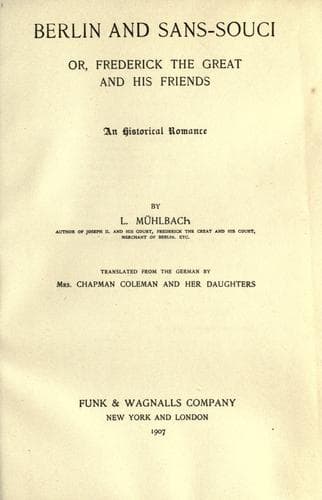
Berlin and Sans-Souci; Or, Frederick the Great and His FriendsMühlbach, L. (Luise)
History
Berlin and Sans-Souci; Or, Frederick the Great and His Friends
Mühlbach, L. (Luise)
Frederick II, King of Prussia, 1712-1786 -- Fiction; Prussia (Germany) -- History -- Frederick II, 1740-1786 -- Fiction
"Still! say no more," whispered the voice; and Trenck knew by its
trembling tones, that the maiden was inspired by the same ardent
passion which glowed in every fibre of his being. That still small
voice sounded in his ears like the notes of an organ: "Say no more,
but listen. To-morrow the Princess Ulrica departs for Sweden, and
the king goes to Potsdam; you will accompany him. Have you a swift
horse that knows the way from Potsdam to Berlin, and can find it by
night?"
"I have a swift horse, and for me and my horse there is no night."
"Four nights from this you will find the window which you know open,
and the door which leads to the small stair, only closed. Come at
the hour of eleven, and you will receive a compensation for the
scarf you have lost this evening. Hush--no word; look not around,
move onward indifferently; turn not your head. Farewell! in four
days--at eleven--go!"
"I had to prepare a coat of mail for him, in order that he might be
invulnerable," whispered Amelia tremblingly; exhausted and
remorseful, she sank back upon the tabouret. "The beautiful Kleist
shall not ravish my beloved from me. He loves me--me alone; and he
shall no longer complain of my cruelty. I dare not be cruel! I dare
not make him unhappy, for she might comfort him. He shall love
nothing but me, only me! If Louise von Kleist pursues him with her
arts, I will murder her--that is all!"
CHAPTER V.
A SHAME-FACED KING.
The king laid his flute aside, and walked restlessly and sullenly
about his room. His brow was clouded, and he had in vain sought
distraction in his faithful friend, the flute. Its soft, melodious
voice brought no relief; the cloud was in his heart, and made him
the slave of melancholy. Perhaps it was the pain of separation from
his sister which oppressed his spirit.
The evening before, the princess had taken leave of the Berliners at
the opera-house, that is, she had shown herself to them for the last
time. While the prima donna was singing her most enchanting
melodies, the travelling carriage of Ulrica drove to the door. The
king wished to spare himself the agony of a formal parting, and had
ordered that she should enter her carriage at the close of the
opera, and depart, without saying farewell.
The people knew this. They were utterly indifferent to the beautiful
opera of "Rodelinda," and fixed their eyes steadily upon the king's
loge. They thus took a silent and affectionate leave of their young
princess, who appeared before them for the last time, in all the
splendor of her youth and beauty, and the dignity of her proud and
royal bearing. An unwonted silence reigned throughout the house; all
eyes were turned to the box where the princess sat between the two
queens. Suddenly the door was thrown open, and the young Prince
Ferdinand rushed, with open arms, to his sister.
Public-domain text, read in full here on John Shaqi.
Reviews
Reviews
No reviews yet
Be the first to share your thoughts on this work.
Elsewhere in the archive
Join the Discussion
Join the discussion
Sign in to leave a comment or review.
Sign InorCreate an account