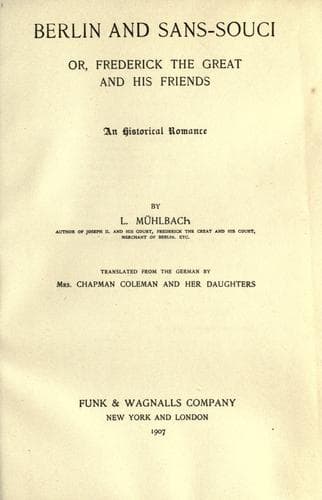
Berlin and Sans-Souci; Or, Frederick the Great and His FriendsMühlbach, L. (Luise)
History
Berlin and Sans-Souci; Or, Frederick the Great and His Friends
Mühlbach, L. (Luise)
Frederick II, King of Prussia, 1712-1786 -- Fiction; Prussia (Germany) -- History -- Frederick II, 1740-1786 -- Fiction
"My dear, dear Ulrica!" he cried, weeping and sobbing painfully,
"must it then be so? Do I indeed see you for the last time?" With
childish eagerness he embraced his sister, and leaned his head upon
her bosom. The princess could no longer control herself; she mingled
her tears with those of her brother, and drawing him softly out of
view, she whispered weeping and trembling words of tenderness; she
implored him not to forget her, and promised to love him always.
The queen-mother stood near. She had forgotten that she was a queen,
and remembered only that she was a mother about to lose her child
forever; the thought of royal dignity and courtly etiquette was for
some moments banished from her proud heart; she saw her children
heart-broken and weeping before her, and she wept with them.
[Footnote: Schneider's "History of the Opera and the Royal Opera-
House."]
The people saw this. Never had the most gracious smile, the most
condescending word of her majesty, won their hearts so completely as
these tears of the mother. Every mother felt for this woman, who,
though a queen, suffered a mother's anguish; and every maiden wept
with this young girl, who, although entering upon a splendid future,
shed hot tears over the happy past and the beloved home. When the
men saw their wives and children weeping, and the prince not ashamed
of his tears, they also wept, from sympathy and love to the royal
house. In place of the gay jest and merry laughter wont to prevail
between the acts, scarcely suppressed sobs were the only sounds to
be heard. The glorious singer Salimberri was unapplauded. The
Barbarina danced, but the accustomed bravos were hushed.
Was it the remembrance of this touching scene which moved the king
so profoundly? Did this eternal separation from his beloved sister
weigh upon his heart? The king himself knew not, or he would not
acknowledge to himself what emotion produced this wild unrest. After
laying his flute aside, he took up Livy, which lay always upon his
writing-table, and tried to read a chapter; but the letters danced
before his eyes, and his thoughts wandered far away from the old
Roman. He threw the book peevishly aside, and, folding his arms,
walked rapidly backward and forward.
"Ah me! ah me! I wish this were the day of battle!" he murmured.
"To-day I should be surely victorious! I am in a fierce and
desperate mood. The wild roar of conflict would be welcome as a
sweet home song in a strange land, and the shedding of blood would
be medicinal, and relieve my oppressed brain. What is it which has
drawn this veil over my spirit? What mighty and mysterious power has
stretched her hand over me? With what bounds am I held a helpless
captive? I feel, but I cannot see them, and cannot tear them apart.
No, no! I will be lord of myself. I will be no silent dreamer. I
will live a true life. I will work, and be a faithful ruler, if I
cannot be a free and happy man."
Public-domain text, read in full here on John Shaqi.
Reviews
Reviews
No reviews yet
Be the first to share your thoughts on this work.
Elsewhere in the archive
Join the Discussion
Join the discussion
Sign in to leave a comment or review.
Sign InorCreate an account