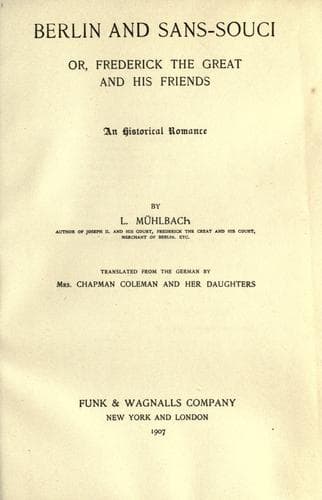
Berlin and Sans-Souci; Or, Frederick the Great and His FriendsMühlbach, L. (Luise)
History
Berlin and Sans-Souci; Or, Frederick the Great and His Friends
Mühlbach, L. (Luise)
Frederick II, King of Prussia, 1712-1786 -- Fiction; Prussia (Germany) -- History -- Frederick II, 1740-1786 -- Fiction
"Perhaps you are right," said the king, smiling. "I do not love war,
but it is sometimes a necessary evil; and if I cannot relieve my
godmother, Maria Theresa, of this mortal malady of pride and
superciliousness without a general blood-letting, I must even play
the physician and open a vein. The alliance with France is
concluded; Charles the Seventh goes to Frankfort for coronation; the
French ambassador accompanies him, and my army stands ready for
battle, ready to protect the emperor against Austria. We will soon
have war, friend, and I hope we will soon have a victory to
celebrate. In a few weeks we will advance. Oh, Rothenberg! when I
speak of battle, I feel that I am young, that my heart is not of
stone--it bounds and beats as if it would break down its prison
walls, and found a new home of glory and fame."
"The heart of my king will be ever young; it is full of trust and
kindliness."
Frederick shook his head thoughtfully. "Do not believe that,
Rothenberg; the hands that labor become hard and callous, and so is
it with the heart. Mine has labored and suffered; it will turn at
last to stone. Then I shall be condemned. The world will forget that
it is responsible; they will speak only of my hard heart, and say
nothing of the anguish and the deceptions which have turned me to
stone. But what of that? Let these foolish two-legged creatures, who
proudly proclaim that they are made in the image of God, say what
they please of me; they cannot deprive me of my fame and my
immortality. He who possesses that has received his reward, and dare
utter no complaint. Truly Erostratus and Schinderhannes are
celebrated, and Eulenspiegle is better known and beloved by the
people than Socrates."
"This proves that Wisdom herself must take the trouble to make
herself popular," said Rothenberg. "True fame is only obtained by
popularity. Alexander the Great and Caesar were popular, and their
names were therefore in the mouths of the people. This was their
inheritance, handed down from generation to generation, from father
to son. So will it be with King Frederick the Second. He is not only
the king and the hero, but he is the man of the people. His fame
will not be written alone on the tablets of history by the Muses;
the people will write it on the pure, white, vacant leaves of their
Bibles; the children and grandchildren will read it; and, centuries
hence, the curious searchers into history will consider this as
fame, and exalt the name of Frederick the Great."
Public-domain text, read in full here on John Shaqi.
Reviews
Reviews
No reviews yet
Be the first to share your thoughts on this work.
Elsewhere in the archive
Join the Discussion
Join the discussion
Sign in to leave a comment or review.
Sign InorCreate an account