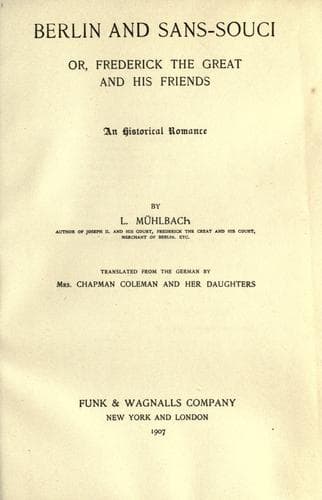
Berlin and Sans-Souci; Or, Frederick the Great and His FriendsMühlbach, L. (Luise)
History
Berlin and Sans-Souci; Or, Frederick the Great and His Friends
Mühlbach, L. (Luise)
Frederick II, King of Prussia, 1712-1786 -- Fiction; Prussia (Germany) -- History -- Frederick II, 1740-1786 -- Fiction
He rang the bell, and ordered the ministers to assemble for a
cabinet council.
"I will work, and forget every thing else," he said, with a sad
smile, and he entered his cabinet with this proud resolve.
This time the king deceived himself. The most earnest occupation did
not drive the cloud from his brow: in fact, it became more lowering.
"I cannot endure this," he said, after walking backward and forward
thoughtfully. "I will put a stop to it. As I am not a Ulysses, I do
not see why I should bind my eyes, and stop my ears with wax, in
order not to see this bewildering siren, and hear her intoxicating
song. In this sorrowful and pitiful world, is it not a happiness to
meet with an enchantress, to bow down to the magic of her charms,
and for a small half hour to dream of bliss? All other men are mad:
why should I alone be reasonable? Come, then, spirit of love and
bliss, heavenly insanity, take possession of my struggling soul. Let
old age be wise and cool, I am young and warm. For a little while I
will play the fool, and forget my miserable dignity."
Frederick called his servant, and sent for General Rothenberg, then
took his flute and began to play softly. When the general entered,
the king nodded to him, but quietly finished his adagio; then laid
the flute aside, and gave his hand to his friend.
"You must be Pylades, my friend, and banish the despondency which
oppresses the heart and head of thy poor Orestes."
"I will be all that your majesty allows or commands me to be," said
the general, laughing; "but I think the queen-mother would be little
pleased to hear your majesty compare yourself to Orestes."
"Ah, you allude to Clytemnestra's faithless love-story, with which,
truly, my exalted and virtuous mother cannot be associated. Well, my
comparison is a little lame, but my despondency is real--deeply
seated as my friendship for you."
"How! your majesty is melancholy? I understand this mood of my
king," said Rothenberg. "It only takes possession of you the day
before some great deed, and only then because the night before the
day of triumph seems too long. Your majesty confesses that you are
sad. I conclude, therefore, that we will soon have war, and soon
rejoice in the victories of our king."
Public-domain text, read in full here on John Shaqi.
Reviews
Reviews
No reviews yet
Be the first to share your thoughts on this work.
Elsewhere in the archive
Join the Discussion
Join the discussion
Sign in to leave a comment or review.
Sign InorCreate an account