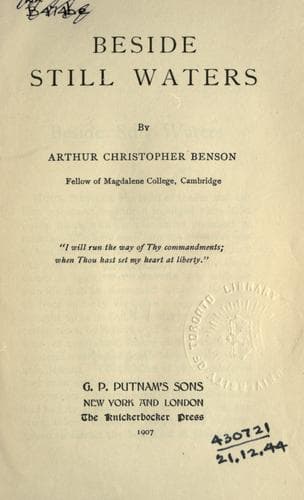
His friend could classify authors, and could give off-hand a brilliant
and well-sustained judgment on their place in literary development,
which fairly astonished Hugh. But the difference seemed to be that his
friend had mastered books with a sort of gymnastic agility, and that
his mind had reached an astonishing degree of technical perfection
thereby; but Hugh felt that to himself books had been a species of
food, and that his heart and spirit had gained some intensity from
them, some secret nourishment, which his friend had to a certain extent
missed.
Hugh had been so stirred on several occasions by a sense of shame at
realising the impotence and bareness of his own mind, that he laid down
an ambitious scheme of self-improvement, and attacked history with a
zealous desire for his own mental reform. But he soon discovered that
it was useless. Such an effort might have been made earlier in life,
before habits had been formed of desultory enjoyment, but it was in
vain now. He realised that accurate knowledge simply fell through his
mind like a shower of sand; a little of it lodged on inaccessible
ledges, but most of it was spilt in the void. He saw that his only
hope was to strengthen and enlarge his existing preferences, and that
the best that he could hope to arrive at was to classify and
systematise such knowledge as he at present possessed. It was too late
to take a new departure, or to aim at any completeness of view. The
mental discipline that he required, and of which he felt an urgent
need, must be attained by a diligent sorting of his own mental stores,
haphazard and disjointed as they were. And after all, he felt, there
was room in the world for many kinds of minds. Mental discipline from
the academical point of view was a very important thing, perhaps the
thing that the ordinary type of public schoolboy was most in need of.
But there was another province too, the province of mental
appreciation, and it was in this field that Hugh felt himself competent
to labour. It seemed to him that there were many young men at the
university, capable of intellectual pleasure, who had been starved by
the at once diffuse and dignified curriculum of classical education.
Hugh felt that he himself had been endowed with an excess of the
imaginative and artistic quality, and that, owing to natural instincts
and intellectual home-surroundings, he had struck out a path for
himself; books had been to Hugh from his earliest years channels of
communication with other minds. He could not help doubting whether
they ever developed qualities or delights that did not naturally exist
in a rudimentary form in the mind which fell under their influences.
He could not, in looking back, trace the originating power of any book
on his own mind; the ideas of others had rather acted in fertilising
the germs which lay dormant in his own heart. They had deepened the
channels of his own thoughts, they had revealed him to himself; but
Public-domain text, read in full here on John Shaqi.
Reviews
Reviews
No reviews yet
Be the first to share your thoughts on this work.
Elsewhere in the archive
Join the Discussion
Join the discussion
Sign in to leave a comment or review.
Sign InorCreate an account