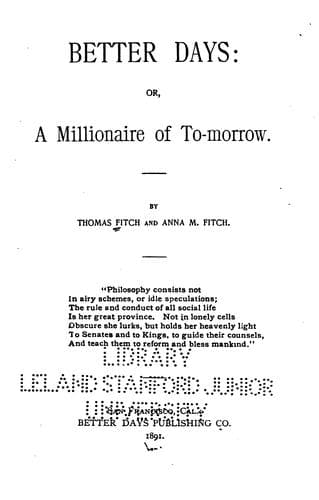
Better days; or, A Millionaire of To-morrowFitch, Thomas
Philosophy
Better days; or, A Millionaire of To-morrow
Fitch, Thomas
Utopias -- Fiction; West (U.S.) -- Fiction
“This is Mr. Morning’s state, I believe,” observed the doctor, after the
laugh at his expense had subsided, and all sat dreamily looking away to
the dimly-outlined mountains in the distance, “and we must be nearing
the place of the wonderful gold deposit, with the results of which he is
rapidly revolutionizing the world.”
“You are right, sir,” said a bright-eyed, smooth-shaven, portly
gentleman, of forty years of age, who occupied an adjoining seat. “It is
Morning’s state in every sense of the word. He has made it—industrially,
politically, and socially. His enterprise and money have constructed
great reservoirs, and laced the land with irrigating canals, and changed
its wastes into orchards, and its deserts into lawns. He is the idol of
its people, as he ought to be, and his ideas are embodied in our
constitution and laws. They are all the product of his thought, from
marriage contract-laws to abolition of trial by jury.”
“Abolition of trial by jury,” said Doctor Eustace.
“Yes, sir; at least the jury is composed of judges, instead of men who
don’t know the plaintiff from the defendant, and we have no Supreme
Court.”
“No jury, and no Supreme Court!” observed Miss Winters. “What a capital
idea. I shall come here to practice.”
“Well, miss, if you practice law here, and wish to patronize the twelve
men in a box, or enjoy the luxury of an appeal, you must bring your case
in the United States Court, or take it there. In our State courts we
have dispensed with all that ancient rubbish.”
“Rubbish!” exclaimed the doctor.
“Even so,” rejoined the stranger. “The judicial system in vogue
elsewhere than in Arizona is as much a relic of barbarism as slavery or
polygamy. It is no more fitted to the wants and enlightenment of the age
than the canal boat for traveling, or the flint lock musket for shooting
pigeons. Suppose you wish to recover a piece of land from a jumper in
California or Maine, and one side or the other demands a jury trial.
Every good citizen who is busy shirks duty as a juryman. Every
intelligent citizen who reads the newspapers forms an opinion and is
excused. From the residue—which is sure to contain both fools and
knaves—you get twelve clerks, mechanics, laborers, merchants, farmers,
and idlers—none of whom have any training in untangling complicated
propositions, weighing evidence, remembering principles of law and
logic, and according to each fact its just and relative importance.
“After these twelve men have listened to a muddle of testimony,
objections, law papers, and speeches, concluding with bewildering
instructions, which half of them fail to remember, and the other half
fail to understand, they retire to the jury room and guess out a
verdict. The losing party appeals, and, after wearisome delay, the
Supreme Court decides that ‘someone has blundered,’ and, without
attempting to correct the error by a proper judgment, sends the case
back for another trial, another batch of blunders, and another appeal.”
Public-domain text, read in full here on John Shaqi.
Reviews
Reviews
No reviews yet
Be the first to share your thoughts on this work.
Elsewhere in the archive
Join the Discussion
Join the discussion
Sign in to leave a comment or review.
Sign InorCreate an account