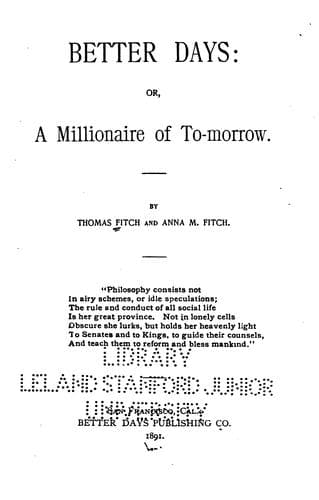
Better days; or, A Millionaire of To-morrowFitch, Thomas
Philosophy
Better days; or, A Millionaire of To-morrow
Fitch, Thomas
Utopias -- Fiction; West (U.S.) -- Fiction
“And how does your Arizona system correct the evils you depict?” queried
the doctor.
“We commence at the other end of the puzzle,” said the stranger. “We
place the Supreme Court in the jury box. We have a preliminary court of
three judges in each judicial district. Every plaintiff must first
present his case informally to this court. He states on oath the facts
he expects to prove, and gives the names of his witnesses. Any willful
mis-statement of a material fact, is perjury. If the evidence would, if
uncontradicted, entitle him to recover, an order is issued giving him
leave to sue. In practice, not one-half of the proposed suits survive
the ordeal. The saving of time and money is great. Under the old system,
after a jury had been impaneled, and days consumed, the plaintiff might,
after all, be nonsuited. Now it is all disposed of in an hour or two.
The preliminary court practically puts an end to all blackmailing
litigation.”
“And when leave to sue is granted, what is the next step?” inquired the
doctor.
“The case is brought under the same rules of procedure as of old,”
replied the stranger, “with only such changes as were necessary to adapt
litigation to the new conditions. We have three judicial districts in
the State, and nine judges for each district. Upon questions of law
arising during the trial, the judges pass by a majority vote, and in
making the final decision, from which there is no appeal, seven judges
must concur.”
“Does this system satisfy litigants?” asked the doctor.
“Much better than the old method,” replied the stranger. “What honest
litigant would not prefer to have his rights determined by nine men, who
were trained to sift truth from error, who were honest and just, and
without other duties to distract them, rather than by twelve men such as
ordinarily find their way into the jury box? The judgment of seven out
of nine judges will be as nearly right as human conclusions can well be,
and people affected by it are better satisfied—even when they lose—than
by the guess of a stupid and sleepy jury.”
“Can the courts you have organized attend to all the business?” asked
the doctor.
“Easily,” was the rejoinder. “No time is consumed in procuring juries,
and much less in objections to testimony. Arguments are abbreviated, and
instructions eliminated. In practice, four cases out of five are decided
from the bench.”
“Are not the salaries of so many judges a heavy tax upon you?” asked the
doctor.
“The system costs the public treasury less than the old one,” was the
reply. “Many court expenses are dispensed with, and the expense to
litigants is reduced, although the loser is now compelled to pay the fee
of his opponent’s attorney, which is fixed by the court.”
“As you have no court of appeals, I suppose no record is made of court
proceedings,” remarked the doctor.
“Oh, yes, each court room is provided with one of the new automatic
noiseless receiving and printing phonographs.”
“And how about lawyers who have bad cases?”
Public-domain text, read in full here on John Shaqi.
Reviews
Reviews
No reviews yet
Be the first to share your thoughts on this work.
Elsewhere in the archive
Join the Discussion
Join the discussion
Sign in to leave a comment or review.
Sign InorCreate an account