Better days; or, A Millionaire of To-morrow — John Shaqi
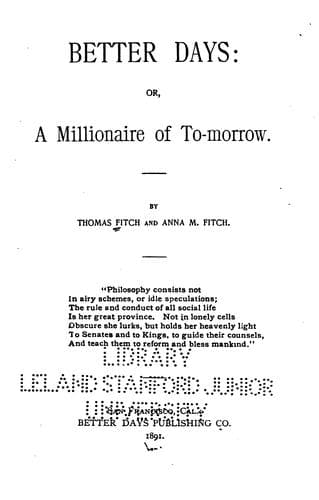
Better days; or, A Millionaire of To-morrowFitch, Thomas
Philosophy
Better days; or, A Millionaire of To-morrow
Fitch, Thomas
Utopias -- Fiction; West (U.S.) -- Fiction
If, as a consequence of Morning’s find, gold should not be demonetized,
if it should be permitted to remain as a measurer of all values, and the
extent of the deposit should be made known to the world, the inevitable
result would be to quadruple the prices of land, labor, and goods, and
to reduce to one-fourth of their present proportions the value to the
creditor of all existing indebtedness. The farmer whose land was worth
$10,000 would find it worth $40,000, and the man who had loaned $5,000
upon it would find his loan worth but $1,250 practically, because the
purchasing power of his $5,000 would be reduced to one-fourth of its
present capacity.
All government bonds of the nations, all county, city, and railroad
bonds, and all the mortgages and promissory notes and book accounts in
the world, would, if all of Morning’s gold should be poured at once into
circulation, without preparation or warning, be reduced at one blow to
one-fourth of their present value, and all the owners of land, and
implements, and horses, and cattle, and merchandise would find their
value at once increased fourfold. The laborer who had only his hands or
his brains would remain unaffected. His wages would be quadrupled, and
so would the cost of his living.
Knowledge of the extent of the Morning mine would immediately enrich the
debtors and ruin the creditors of the world, unless the governments of
earth should demonetize gold, deny it access to the mints, refuse to
coin it, and so degrade it to a commodity.
An illustration in a small way of the operations of this immutable law
of finance may be found in the history of San Francisco. The foundations
of some of the great fortunes of that city may be traced to the days of
the Civil War, when San Francisco wholesale merchants paid their Eastern
creditors in legal tender currency, the while they diligently fostered a
public sentiment which made it discreditable to the honesty and ruinous
to the credit of any California retailer who should attempt to pay his
debt to them in the despised greenbacks. The interior storekeeper glowed
with pride when Ephraim Smooth & Company gathered in his golden
twenties, and commended his honesty for “paying his debts like a man, in
gold, and not availing himself of the dishonest legal tender law.” But
Smooth & Company paid their New York creditors in greenbacks, and
pocketed the difference.
Public-domain text, read in full here on John Shaqi.
Reviews
Reviews
No reviews yet
Be the first to share your thoughts on this work.
Join the Discussion
Join the discussion
Sign in to leave a comment or review.
Sign InorCreate an account