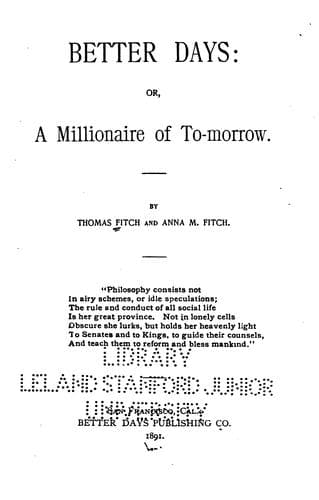
Better days; or, A Millionaire of To-morrowFitch, Thomas
Philosophy
Better days; or, A Millionaire of To-morrow
Fitch, Thomas
Utopias -- Fiction; West (U.S.) -- Fiction
Morning calculated that the amount of money needed for labor, supplies,
machinery, and buildings, to work the mines in accordance with his
plans, would be about $300,000, and his first thought was to obtain this
money by breaking down, and shipping to reduction works in California or
Colorado, about thirty tons of the quartz before he should commence the
work which he projected for the concealment of the ledge.
With his own hands he could mine and sack such an amount of ore in a
fortnight, and with the aid of half a dozen pack animals, managed by
himself, transport it a mile or two from the rift, where it might be
thrown into the channel cut by the waterspout, and, with a blast or two,
be covered with rocks and dirt until teams should be brought from Tucson
for it.
With this idea uppermost, he sought the freight agent of the railroad
company of Tucson.
Then he came in contact with the system in vogue on the Pacific
Coast—and possibly elsewhere—that of a one-sided railroad partnership
with the producer, on the basis that the producer furnish all the
capital and suffer all the losses, the railroad company providing
neither capital, experience, nor services, but taking the lion’s share
of the profits.
“What,” said Morning, “will your freight charges be for three car loads
of ore to Pueblo or San Francisco?”
“What kind of ore?”
“Gold-bearing quartz in sacks.”
“What does your ore assay?” inquired the agent.
“What has that got to do with it?” questioned Morning sharply.
“Everything,” answered the official. “We charge in car-load lots $12 per
ton to San Francisco, or $24 per ton to Pueblo, and $2.00 per ton in
addition for each $100 per ton of the assay value of the ore.”
“Very well,” said Morning, “I believe I will ship thirty tons to San
Francisco.”
“Have you it here?” said the agent.
“It will not be ready for some weeks yet,” replied Morning.
“You did not mention its value,” said the agent.
“I will state its value at $100 per ton,” said Morning.
“All right,” said the agent, “we will take it at that, subject, of
course, to assay according to our rules by the assayer of the company at
your expense.”
“Well, I don’t know that I care to trouble the assayer of your company,”
replied Morning. “In fact, the ore is a good deal richer than $100 per
ton. But I will ship it at that valuation, and release the company from
all liability for loss or damage beyond that. In brief, I will take all
the chances, and if the ore shall be lost, or stolen, or tumbled off a
bridge, or overturned into a river, the company will only account to me
for it at $100 per ton. I suppose that will be satisfactory?”
The agent shook his head.
“It looks as if it ought to be satisfactory,” said he, “but my orders
are imperative. The ore must be assayed, and you will have to pay two
per cent of its value.”
Public-domain text, read in full here on John Shaqi.
Reviews
Reviews
No reviews yet
Be the first to share your thoughts on this work.
Join the Discussion
Join the discussion
Sign in to leave a comment or review.
Sign InorCreate an account