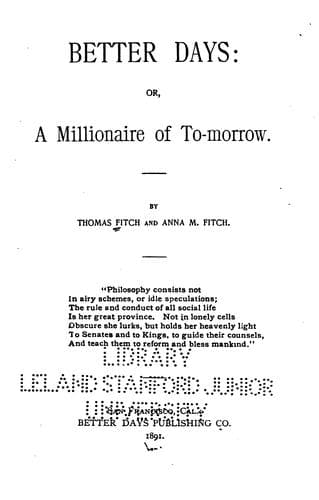
Better days; or, A Millionaire of To-morrowFitch, Thomas
Philosophy
Better days; or, A Millionaire of To-morrow
Fitch, Thomas
Utopias -- Fiction; West (U.S.) -- Fiction
“The census returns tell only a part of the story, doctor. The cottages
of the land will tell you that while as a nation we may have grown of
late years very rich and prosperous, yet among the individuals composing
the nation its wealth is possessed and its prosperity enjoyed within a
very narrow circle. The value of all the property in the United States
in the year 1890 was $66,000,000,000. Do you know that $40,000,000,000,
or sixty per cent of the wealth of America, is owned by less than forty
thousand people? Do you know that in the last twenty years the laborers
of the United States have added to the general wealth of the nation,
values amounting to $30,000,000,000?”
“Well, what is there to complain of in that fact?” questioned the
doctor.
“The complaint is that the money has not been divided among the ten
million workers who earned it. The complaint is that it has not
furnished each of ten million households with a $3,000-shield against
the assaults of poverty. The complaint is that as fast as created it has
been seized by the centripetal tendency which now dominates our
civilization and hurried into the strong boxes of ten thousand
Past-Masters of the art of accumulating the earnings of other people.”
“The complete answer, professor, to your diatribe is that the
accumulations of which you speak are not the earnings of other people.
The greater portion of this wealth has been developed from the bounty of
nature in ways which could not have been pursued without large
combinations of capital.”
“That is a mere assumption, doctor.”
“Not at all, professor. The money taken from gold, silver, copper, lead,
iron, and coal mines, has come from the treasure vaults of nature, and
has not been filched from the earnings of anybody.”
“Mining is the one exception to the rule, doctor.”
“I beg your pardon, professor, but it is not. Another avenue to wealth
has been the organization and reorganization of great industries on
unwasteful and remunerative principles. For instance, the beef and pork
packing establishments of the West supply the retail butchers of the
land with meat at a less price than is paid for the live cattle.”
“Where, then, doctor, do these philanthropists of whom you speak make
their money?”
“They make it, professor, by scientific utilization of the hoofs and
horns, bones and blood, which in small butcher shops are necessarily
wasted.”
“You believe, then, in the rightfulness of monopolies and trusts, do
you, doctor?”
“John, there are no monopolies. No restrictions are placed by law on any
man who chooses to embark in any reputable business. As for the
much-abused ‘trusts,’ they have all resulted in higher wages and more
constant employment to the workman, and lower prices and better goods to
the consumer. I suppose you will not claim that the capitalists alone
are responsible for all the crime and pauperism of the land?”
Public-domain text, read in full here on John Shaqi.
Reviews
Reviews
No reviews yet
Be the first to share your thoughts on this work.
Join the Discussion
Join the discussion
Sign in to leave a comment or review.
Sign InorCreate an account