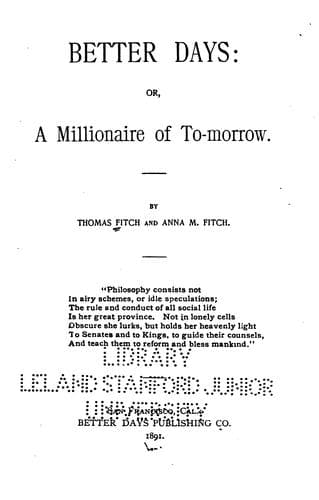
Better days; or, A Millionaire of To-morrowFitch, Thomas
Philosophy
Better days; or, A Millionaire of To-morrow
Fitch, Thomas
Utopias -- Fiction; West (U.S.) -- Fiction
In that day professional labor agitators will lose their vocations, the
workingman who never works will be without influence among his fellows,
and the brotherhoods of beer and brawling which infest the purlieus of
our larger cities, and clamor for bread or blood—meaning always somebody
else’s bread or somebody else’s blood—will find occasion to disband. I
do not despair of relief, I know that it must come. Whether it shall
come through ‘a preserving or a destroying revolution,’ whether it shall
come in wrath or in peace, is a question which the capitalists of this
country must answer and answer speedily.”
“John, you dear old dreamer,” said the doctor, “I know of one
millionaire whose gold has not corroded his humanity. I hope there are
many such, but I fear that if the world looks to its wealth owners to
lead it in a crusade of unselfishness, it will wait a long, long time.
But I do not diagnose the disease as you do. You resemble a boy who has
stubbed his toe. To him there is no world and hardly any boy outside of
that sore toe. Yet if the cure be left to nature, in time the pain will
abate and the toe recover. I do not believe that any law framed by man
can make a pound of flour out of half a pound of wheat, or that any
scheme of government can equalize the inevitable inequalities of human
life.”
“Then you do not believe in the wisdom and beneficence of compelling the
rapacious rich to aid the deserving poor?”
“No; I believe in the wisdom and beneficence of exact justice. I believe
that the skillful and rapid bricklayer is entitled to higher wages and
greater opportunities of employment than his stupid and slothful
associate, and that to deny the former his rightful advantage is an
outrage upon justice, whether such outrage be perpetrated by an employer
or a trades union. I believe that every man is fairly entitled to all
the fruits of his labor, his skill, his good judgment, and his good
luck. The pickerel at your feet came by chance to your hook and not
mine, and therefore it is your fish and not my fish.”
“But by the law of nature, doctor, there is no difference between a
beggar and a king.”
“There is where you are wrong, professor. The law of nature is a
universal statute of equality of opportunity and inequality of result,
and man distorts her purposes and violates her statutes when he places
an unearned crown on the head of a king, or an unearned crust in the
mouth of a beggar.”
“Do you think, then, that man has no excuse for his shortcomings,
doctor?”
Public-domain text, read in full here on John Shaqi.
Reviews
Reviews
No reviews yet
Be the first to share your thoughts on this work.
Join the Discussion
Join the discussion
Sign in to leave a comment or review.
Sign InorCreate an account