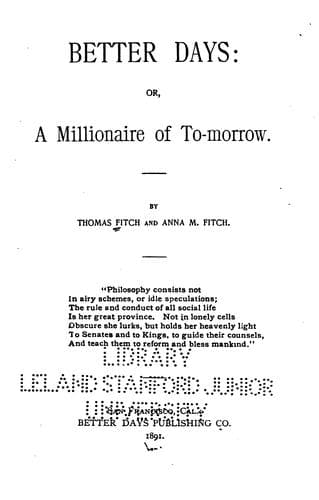
Better days; or, A Millionaire of To-morrowFitch, Thomas
Philosophy
Better days; or, A Millionaire of To-morrow
Fitch, Thomas
Utopias -- Fiction; West (U.S.) -- Fiction
It was busy times at Waterspout, for such was the name given to the new
camp, for the next six weeks. By that time the sawmill and shingle
machine had turned out sufficient material, and with the carpenters and
a number of the wood-choppers who were drafted for the purpose, eighty
comfortable board houses had been constructed, with large buildings for
shops and offices, and a suitable edifice for a schoolhouse. Water was
piped to the little plaza about which the buildings were gathered, and
all was ready for the miners.
The sawmill was now set to work getting out timbers for a mill, and for
timbering tunnels. The men were all alive with curiosity to know where
was the mine for the working of which all these preparations were made,
but both Morning and Steel were reticent, and those who were too
pressing in their inquiries were quietly given to understand that a
continuation of questioning might cause their services to be dispensed
with.
All being ready, the teams were sent to Tucson at the appointed time and
returned with the miners and their household effects, a number of wagons
chartered for the purpose bringing the women and children. Twenty or
more adventurers on horseback and in wagons accompanied the party, as by
this time curiosity was all ablaze at the proceedings of Morning, whose
location notices had been read by hundreds, and been made the subject of
frequent comment in the Tucson papers.
Numerous prospecting parties were dispatched to the Santa Catalinas
during the next few months, and their members climbed all over the
mountains, examined Morning’s location monuments, and returned to Tucson
with the report that the Colorado man was clean crazy, that there was
not a sign of quartz, or any place where quartz could exist, and that
Morning’s friends—if he had any—would do well to appoint a guardian for
him.
The plan of production upon which Morning had settled was to extract
sufficient gold to gradually substitute that metal for paper, or to make
it instead of bonds or credits the basis for paper money in all the
civilized world, and to increase the circulation of all countries to the
volume _per capita_ of the country having the largest amount.
He learned from the statistics with which he had supplied himself that
the money circulation of France, the most prosperous and the most
commercially active nation in Europe, was $42.15 _per capita_, of the
United States $24.10, of Great Britain $20.40, of Italy $16.31, of Spain
$14.44, and of Germany, $14.23. In the Asiatic, semi-Asiatic and South
American countries the money circulation was still less, being but $5.20
_per capita_ in Russia, $3.18 in Turkey, $4.02 in British India, $4.90
in Mexico, $4.29 in Peru, $1.79 in Central America, and $1.29 in
Venezuela.
Public-domain text, read in full here on John Shaqi.
Reviews
Reviews
No reviews yet
Be the first to share your thoughts on this work.
Join the Discussion
Join the discussion
Sign in to leave a comment or review.
Sign InorCreate an account