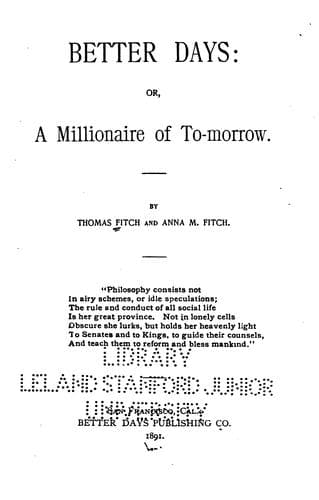
Better days; or, A Millionaire of To-morrowFitch, Thomas
Philosophy
Better days; or, A Millionaire of To-morrow
Fitch, Thomas
Utopias -- Fiction; West (U.S.) -- Fiction
It chanced that David Morning, on his departure from Waterspout for New
York, while riding from the Rillito station into Tucson, and riding by
night, to avoid the heat of an Arizona sun, was seen by the Indians,
who, having emerged from a defile in which they had been concealed
during the day, were now stealthily and swiftly journeying in the same
direction. The opportunity to murder a white man was one not to be
neglected, but the report of a rifle might attract attention and
instigate speedy pursuit, so two of Geronimo’s followers were detailed,
armed only with bows and arrows, to follow the wayfarer through the
dusk, and bring back a scalp, that might be obtained without danger and
without noise.
If Morning had been riding a horse, this tale might have had sudden
ending, but he had found for his necessarily frequent journeys between
the mine and Tucson no such convenient and comfortable mode of
transportation as a seat upon the back of Julia. The equine in question
was a large jet black saddle mule bred at the ranch of Señor Don Pedro
Gonzales, which was situated at the foot of the mountain, on the
opposite side of the Rillito Valley, about three miles from the road.
The mule, as an animal, is often both misrepresented and misunderstood.
No creature tamed by man has keener instincts or greater sagacity, or is
governed to so great an extent by intelligent self-interest. A mule is
always logical. His ordinary reasoning is a syllogism without a flaw. A
horse impelled by high spirit, and patient even unto death, will travel
until he drops from exhaustion, and will pull or carry without complaint
a load that causes his every muscle to pulse with the pain of weariness.
But where lives the man who was ever able to impose upon a mule? Strap
an unaccustomed or unjust load upon the back of this animal of
unillustrious paternity, and he will not move except in the direction of
lying down. Attempt to ride or drive him past his rightful and usual
resting-place, and there may be retrogression, and there may be a
circus, but there will be no advance.
In addition to his other virtues a mule has an exceedingly keen scent.
He seeks no close acquaintance with either grizzly bears or Indians. He
will get the wind of either of his aversions as quickly as a hound will
whiff a deer, and, like the hound, he will give his knowledge to the
world, in a voice that is resonant, magnetic, and—on the whole—musical.
The bray of an earnest mule is not after the Italian but the Wagnerian
school. It is not the sweet, tender tenor of Manrico, it is Lohengrin
sounding his note of power. It is not, perhaps, equal to an orchestra of
nightingales, but it has a rhythm, and passion, and power, and
sweetness, nevertheless.
The quick instinct of Julia caught the scent of the Apache assassins,
and as they crept up she was engaged in a struggle with her rider, who,
with voice and spur, was vainly endeavoring to induce and compel her to
proceed along the usual road.
Public-domain text, read in full here on John Shaqi.
Reviews
Reviews
No reviews yet
Be the first to share your thoughts on this work.
Elsewhere in the archive
Join the Discussion
Join the discussion
Sign in to leave a comment or review.
Sign InorCreate an account