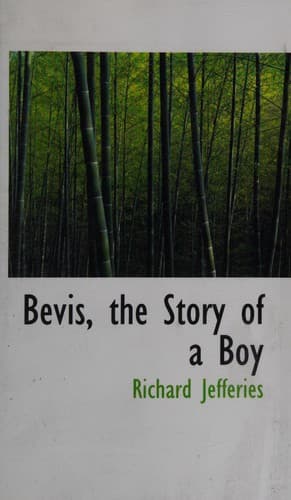
Boys -- Juvenile fiction; England -- Juvenile fiction
Bevis
The Story of a Boy
By
Richard Jefferies
Published by Sampson Low, Marston, Searle, & Rivington,
London. This edition dated 1882.
Volume One, Chapter I.
BEVIS AT WORK.
One morning a large wooden case was brought to the farmhouse, and Bevis,
impatient to see what was in it, ran for the hard chisel and the hammer,
and would not consent to put off the work of undoing it for a moment.
It must be done directly. The case was very broad and nearly square,
but only a few inches deep, and was formed of thin boards. They placed
it for him upon the floor, and, kneeling down, he tapped the chisel,
driving the edge in under the lid, and so starting the nails. Twice he
hit his fingers in his haste, once so hard that he dropped the hammer,
but he picked it up again and went on as before, till he had loosened
the lid all round.
After labouring like this, and bruising his finger, Bevis was
disappointed to find that the case only contained a picture which might
look very well, but was of no use to him. It was a fine engraving of
“An English Merry-making in the Olden Time,” and was soon hoisted up and
slung to the wall. Bevis claimed the case as his perquisite, and began
to meditate what he could do with it. It was dragged from the house
into one of the sheds for him, and he fetched the hammer and his own
special little hatchet, for his first idea was to split up the boards.
Deal splits so easily, it is a pleasure to feel the fibres part, but
upon consideration he thought it might do for the roof of a hut, if he
could fix it on four stakes, one at each corner.
Away he went with his hatchet down to the withy-bed by the brook (where
he intended to build the hut) to cut some stakes and get them ready.
The brook made a sharp turn round the withy-bed, enclosing a tongue of
ground which was called in the house at home the Peninsula, because of
its shape and being surrounded on three sides by water. This piece of
land, which was not all withy, but partly open and partly copse, was
Bevis’s own territory, his own peculiar property, over which he was
autocrat and king.
He flew at once to attack a little fir, and struck it with the hatchet:
the first blow cut through the bark and left a “blaze,” but the second
did not produce anything like so much effect, the third, too, rebounded,
though the tree shook to its top. Bevis hit it a fourth time, not at
all pleased that the fir would not cut more easily, and then, fancying
he saw something floating down the stream, dropped his hatchet and went
to the edge to see.
Public-domain text, read in full here on John Shaqi.
Reviews
Reviews
No reviews yet
Be the first to share your thoughts on this work.
Join the Discussion
Join the discussion
Sign in to leave a comment or review.
Sign InorCreate an account