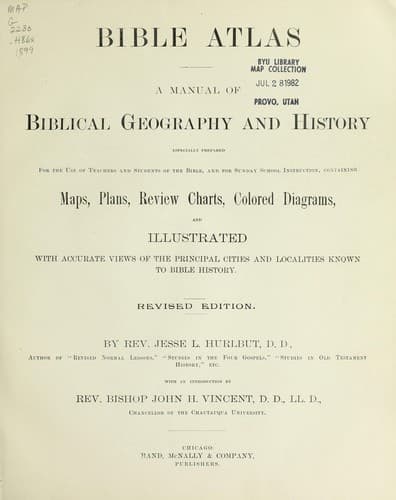
Bible Atlas: A Manual of Biblical Geography and HistoryHurlbut, Jesse Lyman
Religion
Bible Atlas: A Manual of Biblical Geography and History
Hurlbut, Jesse Lyman
Bible -- Geography; Bible -- Geography -- Maps; Bible -- History of Biblical events
VI. =The Tribe of Benjamin= (Josh. 18:11-28) was located between Judah
and Ephraim, having the Jordan on the east, and Dan on the west. It was
a small country, 25 miles long by 12 wide, yet rich in natural
advantages; and many events of Bible history took place within its
borders. It included 26 cities, of which the most important were:
Gilgal, the military capital during the conquest; Jericho, the first
town taken on the west of the Jordan; Jerusalem, long held by the
Jebusites, but from the time of David the capital of the country;
Bethel, connected with many events; Ramah, the home of Samuel; Gibeah,
the residence of King Saul; Michmash, Gibeon and Mizpeh, the places of
famous battles. No portion of the land contains more of Jewish history
than Benjamin, the smallest of all the tribes of Israel.
[Illustration: COMPARATIVE POPULATION OF THE TWELVE TRIBES AT THE
ENTRANCE INTO CANAAN.]
Judah, 306,000.
Dan, 257,600.
Issachar, 257,200.
Zebulon, 242,000.
Asher, 213,600.
Manasseh, 210,800.
Benjamin, 182,400.
Naphtali, 181,600.
Reuben, 174,920.
Gad, 162,000.
Ephraim, 130,000.
Simeon, 88,800.
Levi, 46,000.
VII. =The Tribe of Dan= (Josh. 19:40-48; Judges 18) was situated between
Benjamin and the sea, and, though apparently large, was in reality very
small, since nearly all its territory was held by the original
inhabitants, the Canaanites. Its southernmost town was Timnath, a small
village not on the map, but two miles west of Beth-shemesh; its northern
limit was a brook just north of Joppa. The original inhabitants proved
too strong for the Danites, who were compelled to maintain a sort of
fortified camp in and between the villages of Zorah and Eshtaol, called
"the camp of Dan." (Judges 13:25.) A part of the tribe migrated
northward, as related in the interesting account in Judges 17, 18; and,
by a surprise, seized the Phoenician village of Laish, or Leshem, in the
far north of Palestine, changed its name to Dan, and made it a new
rallying centre for the tribe. This place, with Beersheba on the south,
was named, in the expression "from Dan to Beersheba," as one of the
limits of the land. It remained for centuries the place of an idolatrous
worship, perpetuated under all the changes of government, down to the
final captivity of the land.
Public-domain text, read in full here on John Shaqi.
Reviews
Reviews
No reviews yet
Be the first to share your thoughts on this work.
Elsewhere in the archive
Join the Discussion
Join the discussion
Sign in to leave a comment or review.
Sign InorCreate an account