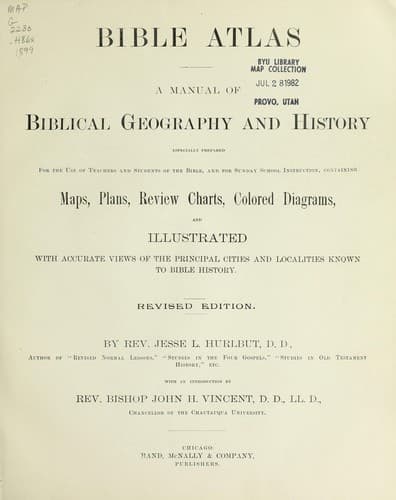
Bible Atlas: A Manual of Biblical Geography and HistoryHurlbut, Jesse Lyman
Religion
Bible Atlas: A Manual of Biblical Geography and History
Hurlbut, Jesse Lyman
Bible -- Geography; Bible -- Geography -- Maps; Bible -- History of Biblical events
VIII. =The Tribe of Ephraim= (Josh. 16) was located on the north of
Benjamin and Dan, and extended from the Jordan to the Mediterranean, in
the centre of the country. But inasmuch as the Canaanites were able to
resist the power of the Ephraimites on both sides of the mountain,
toward the river Jordan and toward the sea, the haughty tribe deemed its
possession too small for its needs, and asked a larger space of Joshua.
They were answered in a half-jesting, half-rebuking manner by the
leader, and urged to drive out the enemy and make for themselves more
room, a counsel which they followed only in part. (Josh. 17:14-18;
Judges 1:22-26.) The principal places in "Mount Ephraim" (as the
district of this tribe was generally called) were: Shechem, between the
twin mountains of Ebal and Gerizim; Shiloh, the place of the ark, and
the religious centre of the land; Beth-horon, the field where the
decisive victory of the conquest was won; Timnath, the burial place of
Joshua; and Samaria, built during the kingdom as the capital of the Ten
Tribes.
IX. =The Half Tribe of Manasseh, West= (Josh. 17), was located north of
Ephraim, and extended from the Jordan to the Mediterranean. Its boundary
followed the northern slope of Mount Carmel, except by the sea, where
the mountain was given to Asher. The lowlands on the Jordan, the Plain
of Esdraelon, and the Mediterranean, were held by the Canaanites, in the
cities of Dor, Megiddo, Taanach and Beth-shean, a chain of fortresses
which gave control of the larger portion of the province, so that the
Manassites were restricted to the mountains, where they occupied Geba,
Dothan and Jarmuth.
X. =The Tribe of Issachar= (Josh. 19:17-23) was allotted the Plain of
Esdraelon (which it was never able to possess), and the mountains of
Tabor and Little Hermon ("Hill of Moreh"), extending to the Jordan south
of the Sea of Chinnereth (Galilee). Both the plain and the Jordan Valley
were held by the Canaanites, but the tribe occupied the mountains. Its
cities were En-gannim, Shunem, Haphraim, Daberath, and Beth-shemesh. The
towns of Cana, Nain and Nazareth, in New Testament history, were located
in this tribe.
XI. =The Tribe of Asher= (Josh. 19:24-31) lay along the sea-coast, and
extended from Mount Carmel to Zidon. Nearly all its cities were
controlled by the Canaanites and Phoenicians, and the people soon
entered into friendly relations with them, and lost their power. A part
of the tribe, however, occupied the mountain range, and retained their
relationship with the rest of the Israelites.
Public-domain text, read in full here on John Shaqi.
Reviews
Reviews
No reviews yet
Be the first to share your thoughts on this work.
Elsewhere in the archive
Join the Discussion
Join the discussion
Sign in to leave a comment or review.
Sign InorCreate an account